

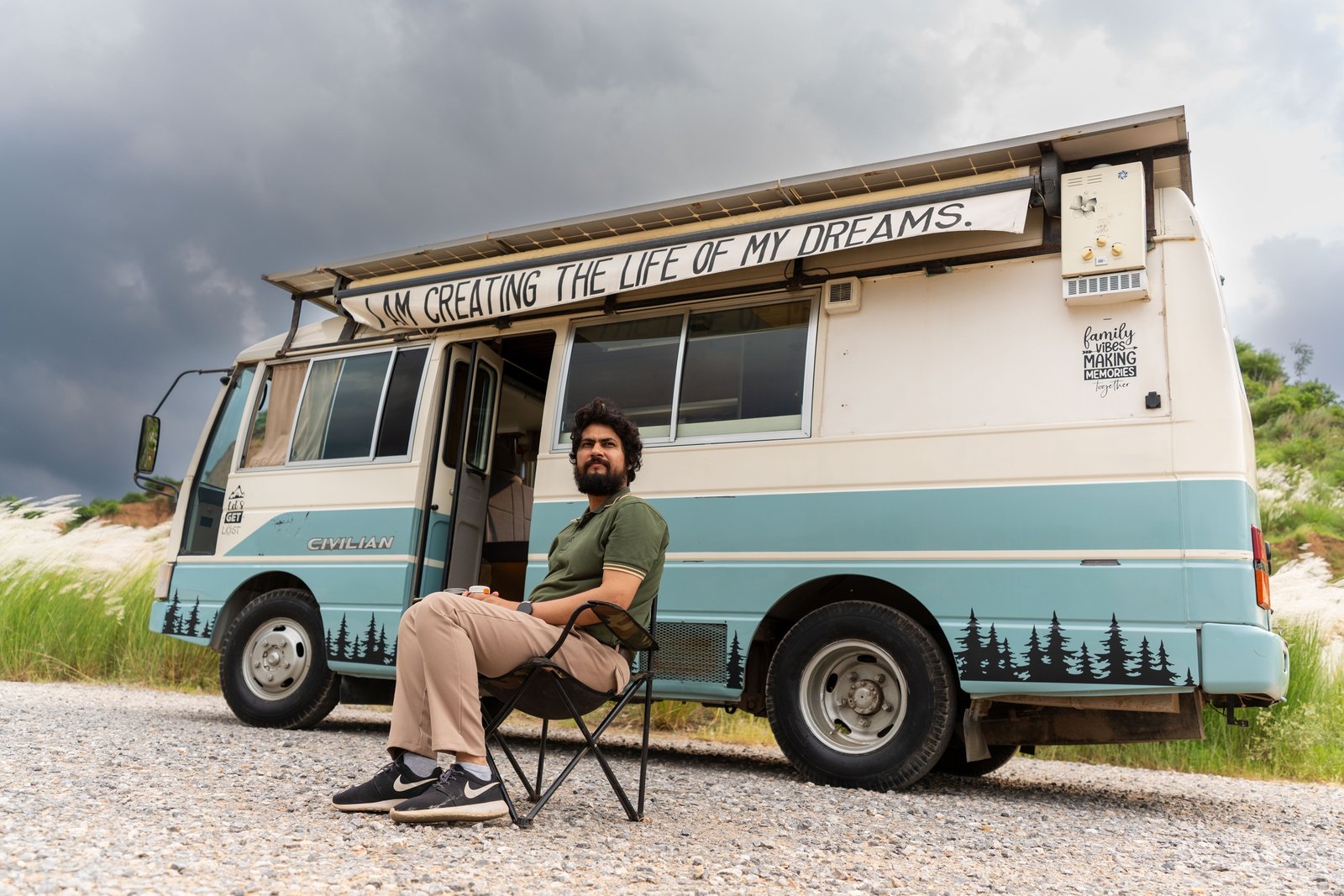
A particular kind of freedom comes with travelling on your own terms. You choose the destination, stop whenever a view catches your eye, and stay as long as you like. For most people, that freedom still comes with a familiar compromise: when the day ends, the comforts of home are somewhere else.
One Pakistani traveler decided to approach the problem differently. Instead of buying a conventional motorhome or settling for a compact camper van, he took a Nissan Civilian bus and set out to build a home inside it. Two years and more than Rs. 1 crore later, the result is a self-contained motorhome with a bedroom, washroom, kitchenette, dining space, air conditioning, and a solar-powered electrical system.
This was not a commercial conversion undertaken to sell campers to customers. It was a personal project built around a simple idea: if travelling across Pakistan was already a regular part of life, why not make the journey more comfortable?
The finished vehicle is as much a reflection of Omer Farooq’s priorities as it is an exercise in engineering. Every major component, from the choice of the base vehicle to the plumbing and electrical systems, had to serve a practical purpose. The objective was not to create the most extravagant motorhome possible, but one that could be used regularly without turning every stop into another chore.
And in Pakistan, where recreational vehicles remain an unusual sight and buying a ready-made motorhome is far from straightforward, that ambition came with challenges extending well beyond the conversion itself.

Owner Profile
- Name: M. Omer Farooq
- Profession: Construction Firm
- Education: ACCA
- Hobbies: Running, Hiking, Traveling, Biking, History
- City: Islamabad
A loving father of three, Omer Farooq is an avid traveler and has traveled many places across Pakistan, including Gwadar, Karachi, and almost all of the Northern areas, either on a bike or a 4×4. His 1995 Nissan Civilian is not just any project for him. It is a testament to his dedication, patience, and passion for building things.
Vehicle Profile
- Model: 1995 Nissan Civilian
- Engine: Toyota 15B
- Transmission: Manual
- Drivetrain: Rear-Wheel Drive (RWD)
- Key Amenities:
- 360-degree camera with Sentry Mode
- Roof-mounted awning
- Roof-mounted solar system
- Full-sized Queen Bed
- Full-sized Split AC Unit
- Instant Geyser
- Fully functional Washroom
- Dining Table
- 6-Speaker Audio system
- Touchscreen Infotainment
- Fully functioning Kitchen
- Multiple cabinets for storage
- Tucked-in Kids Bed
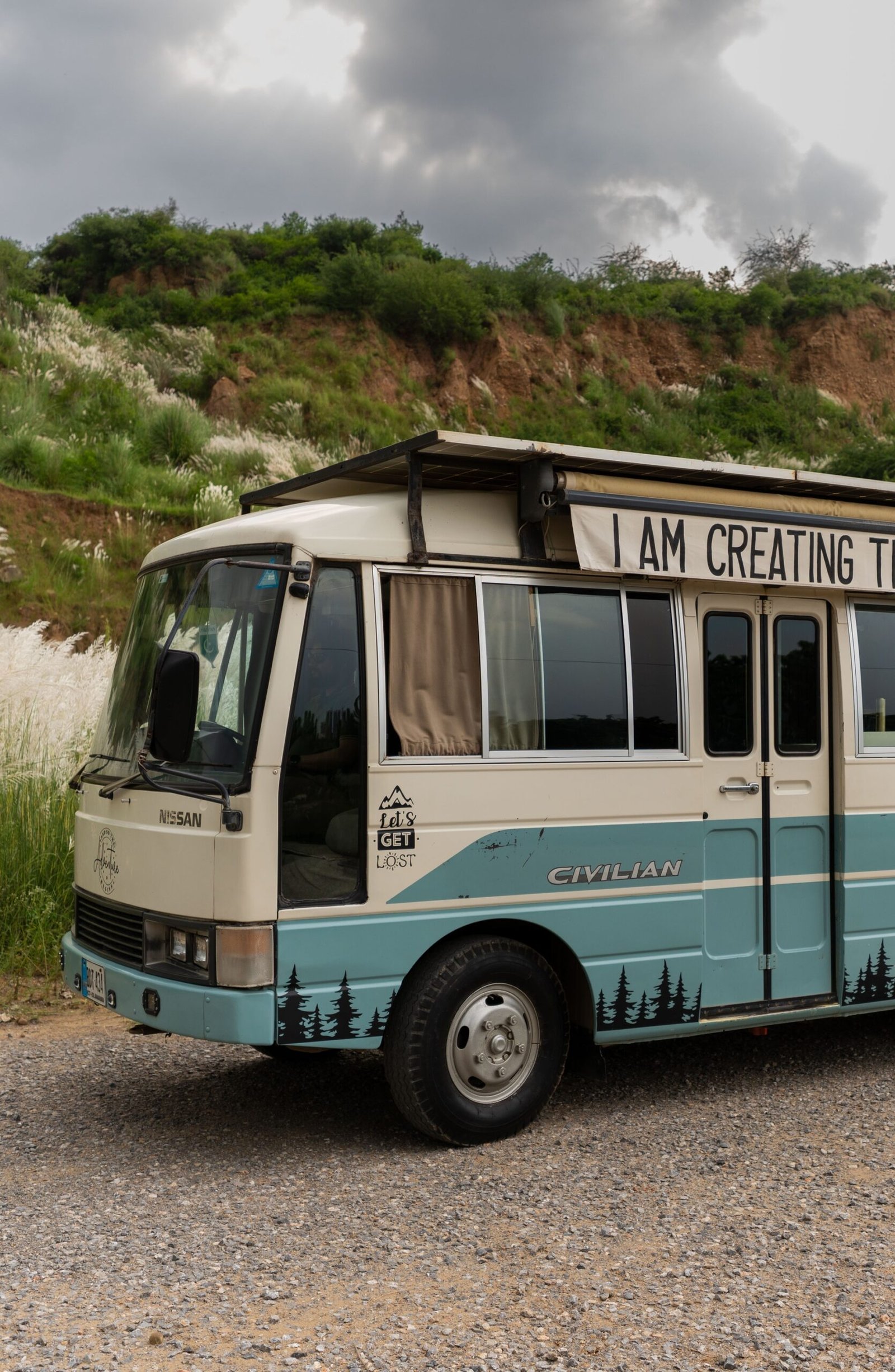
Why Start With a Nissan Civilian?
Choosing the right vehicle was the first major decision. A conventional van conversion might be easier to execute, but fitting a proper bed, a washroom, and a usable kitchen into a smaller platform often means compromising on at least one of them.
Omer considered the Toyota HiAce and Mercedes-Benz Sprinter, but neither suited his requirements as well as the Nissan Civilian. The HiAce was too small for the layout he wanted, while the Sprinter’s ground clearance was not considered suitable for the project. On the other hand, Toyota Coaster’s base vehicle was going out of budget right at the beginning.

The Civilian offered a middle ground. It was large enough to accommodate the essentials of a small home without becoming so unwieldy that city driving would be impractical.
More importantly, the extra space allowed him to avoid one of the most common compromises in smaller camper conversions: replacing a proper bed with a sofa that doubles as a sleeping area or sacrificing a washroom to make room for a larger bed.
With the Civilian, he could have both a full-sized queen bed and a separate washroom, alongside a kitchenette and sitting area.
There was another advantage. Unlike a trailer camper, the Civilian is a self-propelled vehicle. It does not need a separate towing vehicle, which Omer considers particularly important when travelling through hilly terrain or making frequent stops.
Imported motorhomes were another possibility, but Omer says their availability in Pakistan is limited and self-importing one would have been prohibitively expensive.

The Civilian, then, offered the space, mobility, and mechanical foundation he needed. The challenge was turning a passenger bus into something that felt like a home without making it unnecessarily heavy or difficult to maintain.
Designing a Home Inside a Bus
The conversion began on paper before it took shape inside the vehicle.
Omer’s sister is an architect, and she helped develop detailed AutoCAD plans for the project. These drawings established the dimensions of the different areas and helped determine whether everything could fit without making the interior feel cramped.
That planning also changed some of the original ideas.


The initial proposal involved four-inch walls, but the CAD layouts revealed just how much usable space they would consume. Omer instead opted for lightweight PVC and UPVC sheets for much of the interior construction, including partitions and cabinetry.
It was a decision that addressed two problems simultaneously. The thinner materials preserved valuable interior space, while their lower weight helped offset the additional mass introduced by the furniture, appliances, and other equipment.
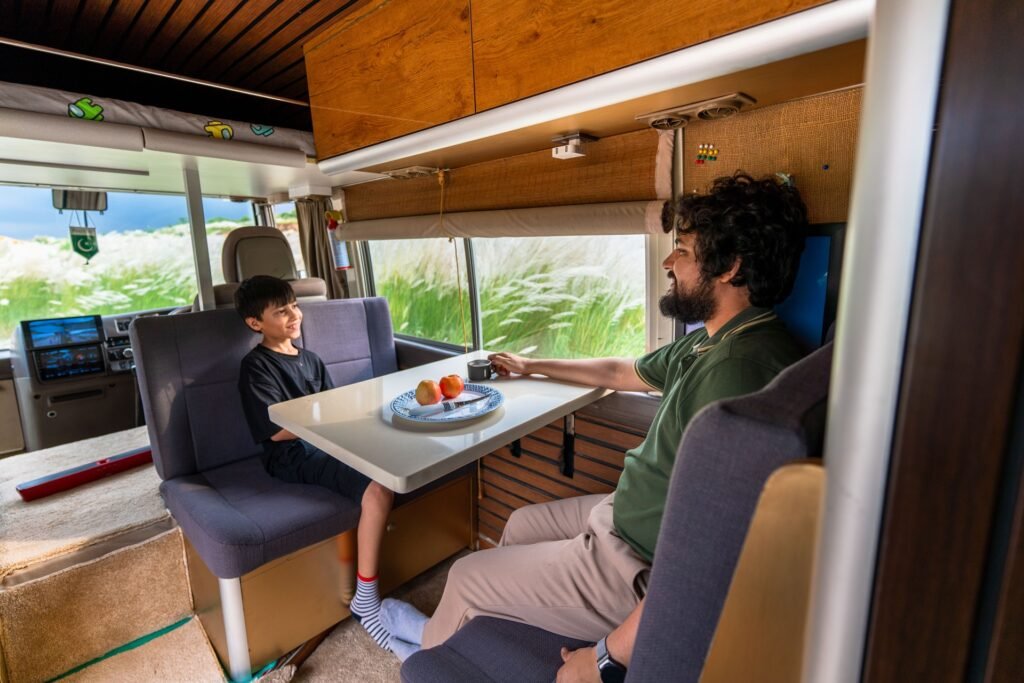
The resulting layout was designed around three primary areas: sleeping, cooking, and washing. A kitchenette provides space for preparing food, while the washroom has its own exhaust fan. The bedroom is built around a queen-sized bed that can also convert into a sofa when it is not needed for sleeping.
That last detail captures the thinking behind the project. Rather than installing furniture simply because it looked luxurious, Omer prioritized flexibility and everyday usability.
The bed is raised above a rear storage compartment, creating room for camping equipment, the electrical hardware, and other essentials. Steel is used where structural strength is necessary, particularly around the bed’s base, but much of the remaining interior relies on lighter materials.
The flooring combines wooden finishes with lightweight supporting materials, while the washroom uses small tiles. Some cabinetry uses lightweight chipboard, and aluminum channels provide additional fittings without adding excessive mass.


There were a few ideas that did not survive the planning stage. Rotating front seats, for example, would have made the living area more flexible, but accommodating them would have required significant changes to the existing layout and potentially sacrificing other features.
A sunroof was also considered. However, the rooftop solar installation occupied much of the available space, while waterproofing and the loss of solar capacity presented additional complications. Omer eventually abandoned the idea, reasoning that the existing windows provided sufficient ventilation.
The approach was consistent throughout: retain the features that make the camper useful and avoid additions that would compromise something more important.
The Engineering Behind the Conversion
Turning a bus into a motorhome involves considerably more than installing furniture and appliances. Water storage, electrical equipment, insulation, and air conditioning all have to work within the constraints of a moving vehicle.
Weight was one of the most important considerations.
Omer says removing the original passenger seats took approximately 400kg out of the vehicle. That weight reduction helped accommodate the solar installation, furniture, water tanks and other conversion equipment. He estimates that the completed camper’s overall weight remains broadly comparable to its original configuration with the passenger seats installed.
Lightweight interior materials were central to achieving that balance.

Omer also made changes to the rear wheel arrangement, removing two of the original rear wheels to create space and reduce weight. The spare tires had to be relocated to accommodate the water tanks beneath the vehicle.
His particular Civilian is fitted with a turbocharged Toyota 15B engine, rather than the naturally aspirated engine found in the standard configuration he describes. He says the engine has not required any major mechanical work since the conversion, although the vehicle continues to receive routine maintenance.
The suspension was also modified slightly. According to Omer, removing some of the leaf suspension made the ride more comfortable on longer journeys. He reports that the braking system did not require an upgrade, although it needed servicing.
The solar installation presented a different challenge. Modern solar panels are generally designed for stationary installations, whereas a vehicle-mounted array has to remain within practical dimensions and withstand the demands of travel.
The Civilian’s roof provided a limited footprint, so Omer sourced six older panels in good condition, each rated at 300 watts. Together, they provide a nominal solar capacity of 1,800 watts.
The mounting structure was designed to keep the panels within the vehicle’s overall dimensions as far as possible, while also accommodating an awning. That required custom fabrication rather than simply placing a conventional residential solar array on the roof.

The rest of the electrical system was built around a 3,000W inverter and a 24V secondary battery setup. Omer also installed a changeover arrangement that allows him to switch between the primary vehicle battery and the secondary battery when necessary.
That arrangement was important because the engine’s starting requirements meant the system could not be designed around the camper’s domestic appliances alone. The vehicle’s own electrical needs had to remain a priority.
The battery arrangement also allows smaller electrical devices to draw power from the primary battery if the secondary battery becomes unavailable. An external power socket provides another practical feature, allowing Omer to power equipment outside the camper when parked.
Omer says the solar system can recharge a fully depleted secondary battery in a day of sunlight under the conditions he has tested. Actual charging time, of course, depends on sunlight, battery condition, and electrical demand.

The system is not intended to power every conceivable appliance. An electric stove or water heater would require substantially more electricity than the current arrangement can comfortably provide. Instead, the setup is built around relatively efficient lighting, a refrigerator, a microwave used for short periods, and a split air-conditioning unit.
That distinction matters. The aim was not to make the camper an unrestricted replacement for a conventional house, but to give it enough electrical independence to make overnight stops and extended trips practical.
Staying Comfortable When the Engine Is Off
Air conditioning proved to be one of the most troublesome parts of the project.
The original bus air-conditioning system had large ducts running along the roof, occupying space needed for the new electrical wiring, cabinets, and other interior fittings. Reworking those ducts without compromising the surrounding structure required considerable effort.

Omer eventually installed smaller pipes and separate lines for the rear vents. Additional fans improved airflow, although they introduced unwanted noise. Even after further adjustments, the original system was not particularly effective on its own, so he now treats it largely as a supplementary source of cooling.
The camper also has a separate split air-conditioning unit with its own indoor and outdoor components. Its outdoor unit is installed in the rear storage compartment, with dedicated vents to allow hot air to escape.
Getting to this arrangement took several attempts. Omer initially experimented with portable air conditioners, but repeated tripping and concerns about heat accumulating around the electrical equipment made them unsuitable.
He eventually settled on the split unit, which can also operate as a heater at lower electrical consumption settings.
Heat remains a challenge during Pakistan’s hotter months. Despite the white exterior, rooftop solar panels and added insulation, Omer says the interior can still become hot. The camper therefore relies on its two separate air-conditioning systems to maintain a comfortable temperature.
Noise is another compromise. The original bus insulation does little to contain the sound of the diesel engine, and the cabin’s many windows add to the challenge. Carpeting in the front section helps reduce some of the noise entering the living area, but Omer acknowledges that the Civilian’s age and original design remain limitations.

Insulation itself required extensive work. Three original windows were replaced with specially moulded PVC sheets, which had to match the shapes of the removed windows and be sealed carefully against rainwater. Other openings and the original roof lining were also addressed with additional insulating materials.
The result is a more suitable living space, but not a perfect one. Omer has prioritised practical improvements over the expectation that a converted passenger bus will behave exactly like a purpose-built motorhome.
A Washroom, Kitchen and Water System That Can Be Repaired Easily
Water management is one of those parts of a camper that becomes easy to overlook until something goes wrong.
With a kitchen and washroom inside the Civilian, Omer needed fresh-water storage, hot and cold water delivery, and a system for disposing of wastewater. The tanks are mounted beneath the vehicle, which required changes to the original spare-wheel arrangement.

Space was again the limiting factor. Omer wanted plumbing that would fit into narrow areas without consuming room needed for cabinets and the washroom itself. He therefore used flexible rubber pipes for the water system rather than the more rigid piping he had considered.
Just as important, he designed the plumbing to be serviceable. The pipes run behind removable panels, allowing him to reach individual sections if a joint leaks or a blockage develops. Because he installed the system himself, he knows where the pipes run and can access the relevant section without dismantling the entire interior.
The arrangement was tested early on. A leaking joint caused the pressure pump to run throughout the night because the system could not build enough pressure for the pump to switch off. The fresh-water tank eventually emptied, but the pump continued operating.
Although the pump survived the incident, the experience prompted him to install a separate switch so it could be shut off during cleaning or whenever a leak was suspected.
The wastewater outlets were also positioned for accessibility. Omer kept the drainage lines exposed beneath the vehicle so that blockages or damage could be addressed without major disassembly.

These are not particularly glamorous details, but they reveal an important distinction between a conversion that looks finished and one designed to be used. A water system that can be inspected and repaired quickly is considerably more useful on a long journey than one hidden permanently behind decorative panels.
Two Years of Trial, Error and Expensive Lessons
The entire conversion took approximately two years. Even now, Omer continues to make small improvements as he identifies things that could work better.
He says he enjoyed the process rather than treating it as a deadline-driven project. Every component required planning, from the positioning of the cameras in his 360-degree camera system to the placement of speakers and the routing of electrical cables.
The electrical system, in particular, became complicated. The vehicle now has separate requirements for different equipment and power networks, including 12V, 24V, and 220V components. Adding six speakers after initially installing only two meant reopening parts of the wiring and interior to accommodate the additional equipment.

The solar installation also involved costly mistakes. An inverter purchased during the early stages did not work with the system, while a battery assembled by a local supplier reportedly contained used cells and failed after about a year.
Omer subsequently replaced it with a branded battery and revised parts of the electrical setup.
These experiences underline the difficulty of sourcing compatible equipment for a project that falls outside conventional automotive and residential electrical applications. Components may be readily available individually, but getting them to operate together reliably is another matter.
Omer believes he could complete a similar build in five to six months if he started again today, largely because he now understands the practical requirements and has already worked through many of the problems.
His advice to anyone considering a similar project is straightforward: understand the vehicle and its systems, even if specialist tradespeople are involved.
He built much of the camper himself at home, bringing in help where technical work required it. He argues that owners should remain closely involved in the process rather than leaving a vehicle at a workshop for months without understanding what has been installed.
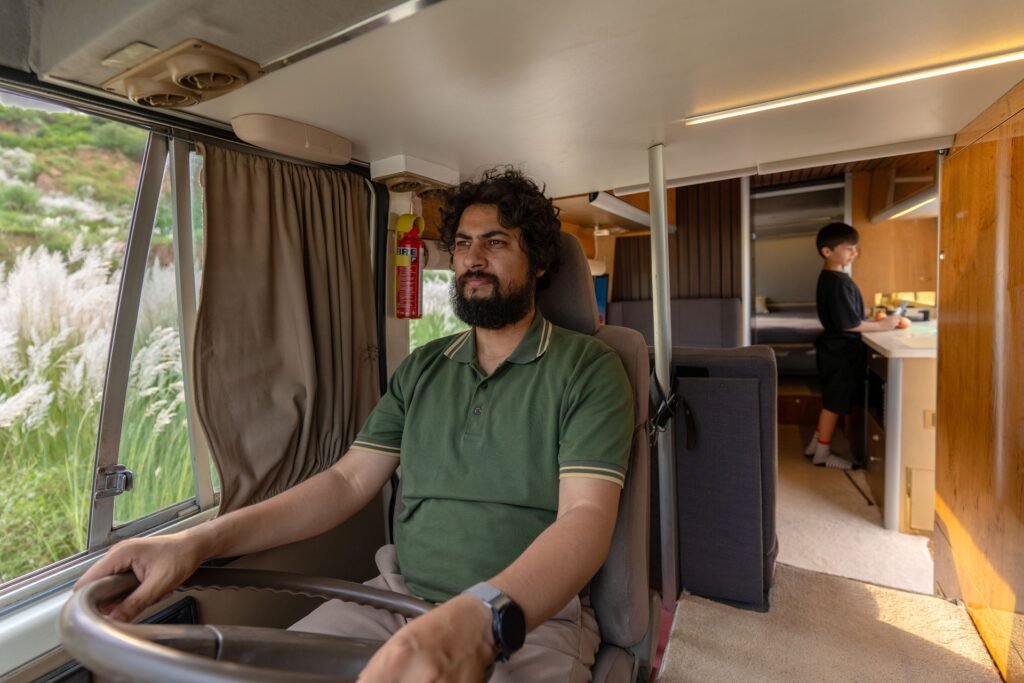
The reasoning goes beyond saving money. A camper travelling for weeks at a time needs to be maintainable, and the owner should know enough about its systems to identify problems and arrange repairs without having to start from scratch.
That philosophy has also shaped the way he approaches future upgrades. At present, he says there is nothing major he would change. A water-level indicator would be convenient, but he has managed without one, and the existing storage and water capacity have generally met his needs.
The Paperwork Nearly Became the Biggest Obstacle
For all the technical challenges, the most stressful part of the project was not the conversion itself. It was getting the vehicle registered.
Omer purchased the Civilian at an auction, but the documentation supplied with it was incomplete. He says he received photocopies of two documents rather than a complete set of original import and ownership records.
The Excise Department required additional documentation before it would proceed. Omer eventually secured further paperwork from NUST University, which had previously owned the bus, and the university was brought into direct contact with the department to help resolve the issue.
The process took approximately nine months.
Even after the documentation problem was addressed, another issue remained: how should a converted bus intended for private travel be classified?


Omer says he was initially told that the vehicle would need to be registered as a commercial bus, which could subject it to route-related restrictions and additional annual fees. That arrangement would have undermined one of the main reasons for building the camper: being able to travel across Pakistan without having to organise route permissions for each destination.
He eventually registered the vehicle through his construction firm and obtained registration under a private-use classification described to him as a vanity van.
The problems did not end there. When he later applied for an M-Tag, he says the vehicle was initially issued a commercial category tag. He was concerned that commercial toll charges could substantially increase the cost of long-distance travel.
His experience highlights a wider administrative challenge for recreational vehicles in Pakistan. Omer says there is no dedicated RV category that adequately reflects how his vehicle is built and used.

A motorhome may be mechanically based on a bus, but it is not necessarily being operated as a passenger transport service. When the registration framework does not clearly accommodate that distinction, owners can find themselves navigating categories that do not neatly fit their intended use.
For this project, the issue was particularly consequential. The vehicle’s entire purpose was to enable flexible travel, and without a workable registration arrangement, the considerable investment in the conversion might not have delivered what Omer wanted.
What Is It Like to Travel in a Home on Wheels?
The most revealing part of the project is what Omer says it feels like to use the finished camper.
He regularly travels to northern Pakistan two or three times a year, a habit that predates the conversion. The Civilian has not fundamentally changed that interest; instead, it has changed what he can take with him.

A full-sized bed, kitchen, washroom, dining table and air conditioning allow him to stop without immediately having to organise accommodation or find somewhere to eat. The solar system provides a degree of independence from external power, while the seating makes the vehicle useful even when it is not being used as a motorhome overnight.
Omer says the rear seating area can accommodate three or four adults, while the dining table can seat around six. There is additional seating towards the front. For a family outing, that means the vehicle can carry a sizeable group without requiring multiple cars.

He distinguishes between using it as a touring vehicle and using it as a camper. While the seating can accommodate a larger group, he considers the sleeping arrangement best suited to a small family, with three adults and two or three children as a practical example.
Nor does every outing have to involve a long drive into the mountains.
Sometimes, he takes the Civilian out for something as ordinary as ice cream with his family. On another evening, he might head towards Daman-e-Koh after picking up pizza from Tehzeeb Bakers. With a working kitchen on board, even a simple stop at a scenic viewpoint can become an opportunity to make tea and spend time together.
That everyday usability is arguably the strongest argument for the conversion. A motorhome that only comes out for a major holiday can easily become an expensive novelty. A vehicle that can also be used for spontaneous outings has a much better chance of becoming part of the owner’s routine.
When asked what surprised him most about the experience, Omer did not point to the solar system or the freedom to travel. Instead, he spoke about the feeling of being at home.

Despite being parked on a road or somewhere in the mountains, he says the interior retains a homely quality. The bed, kitchen, dining area, and washroom make it feel like a familiar living space, even when the surroundings change completely.
He describes that feeling with a line that neatly captures the project’s purpose: “My house is everywhere. It is everywhere where my RV goes.”
Are Home-Built Motorhomes the Future of Touring in Pakistan?
Omer’s experience illustrates both the appeal and the difficulty of building a motorhome locally.
The appeal is obvious. A carefully planned conversion can provide a level of comfort and independence that a regular passenger vehicle cannot offer. It can also be tailored around the owner’s actual needs instead of forcing them to adapt to a standard imported layout.
The difficulties are just as apparent. A project like this requires substantial money, time, technical knowledge, and access to suitable components. Omer estimates that the complete project costs well over Rs. 1 crore, including the vehicle, registration, and conversion.
That figure places this firmly in the realm of a substantial personal investment rather than an inexpensive alternative to ordinary travel. It also does not establish what a commercially produced version would cost, since workshop labour, standardised components and production volumes could change the economics considerably.


The registration experience adds another obstacle. A dedicated and clearly defined framework for motorhomes could make it easier for future owners to understand the requirements before investing in a conversion. The availability of appropriate components, experienced builders and reliable after-sales support would also influence whether the idea could expand beyond a handful of enthusiasts.
Omer says he has encountered very few comparable projects in his area. In his view, some existing conversions prioritise the appearance of luxury over practical use, with limited space and layouts that require too much rearranging whenever the vehicle stops.
His own Civilian was designed around the opposite principle. The bed converts into a sofa, the storage is built into the furniture, and the water and electrical systems can be accessed for maintenance. The idea is to minimise the work required to settle in after reaching a destination.
It is a sensible philosophy for a vehicle that is meant to travel rather than remain parked as a showpiece.

The Civilian also benefits from an important distinction: it does not need to be a modern hybrid or electric vehicle to serve its purpose. Omer values its relatively straightforward diesel engine and believes the mechanical foundation is well suited to his use. That is his assessment of this particular vehicle, rather than a guarantee that every older bus will be equally reliable or economical.
For now, his motorhome remains a personal project rather than a template for a mass-market product. But it demonstrates what is possible when the vehicle, layout, and equipment are planned around a clear purpose.
A Project Without a Finish Line
After two years of work, the Nissan Civilian has become what Omer set out to create: a vehicle that can take his family across the country while carrying many of the comforts of home.
It is not without compromises. Cabin noise remains a concern, hot weather can challenge the insulation, and the electrical system is complicated enough that Omer says he is the only person who fully understands how to repair it. The build also demanded expensive trial and error, alongside a registration process that took months to resolve.
Yet these limitations do not appear to have diminished his satisfaction with the result.

He continues to make small improvements, but no longer feels that the camper needs a major redesign. It can serve as a touring vehicle, provide a place to prepare food and rest, and allow the family to make short trips without turning every outing into a logistical exercise.
When asked whether the project represented an engineering challenge, a lifestyle change or a long-term travel solution, his answer was effectively all three.
He has not abandoned the travelling habits that inspired the build. He has simply found a way to bring more of home along for the journey.
And perhaps that is what makes this Nissan Civilian more interesting than an expensive bus with a bed and a kitchen. Its success is not measured by the number of appliances fitted inside or the amount spent on the conversion. It is measured by how well the vehicle fits into the life of the person who built it.

Omer puts it simply: he can take his family out, park somewhere scenic, make tea and enjoy the evening before heading home. Or he can point the Civilian north and stay on the road for much longer.
For someone who already loves travelling, that is a compelling reason to build a home that moves.
In a country where buying a ready-made motorhome remains difficult, this project is a reminder that the idea is possible. Making it practical, affordable, and straightforward for more people, however, will require more than individual ingenuity. It will also require a better-supported ecosystem for the people who want to build and use these vehicles.
Until then, this Civilian stands as one traveller’s answer to a simple question: if the journey is as important as the destination, why should home have to stay behind?

