
Pakistan Reopens Commercial Used Car Imports Under Strict New Safety and Quality Rules
Pakistan has officially reopened the commercial import of used vehicles, but under a strict new EDB policy framework enforcing UNECE safety standards and two-stage inspections to entirely block accidental and meter-tampered cars.

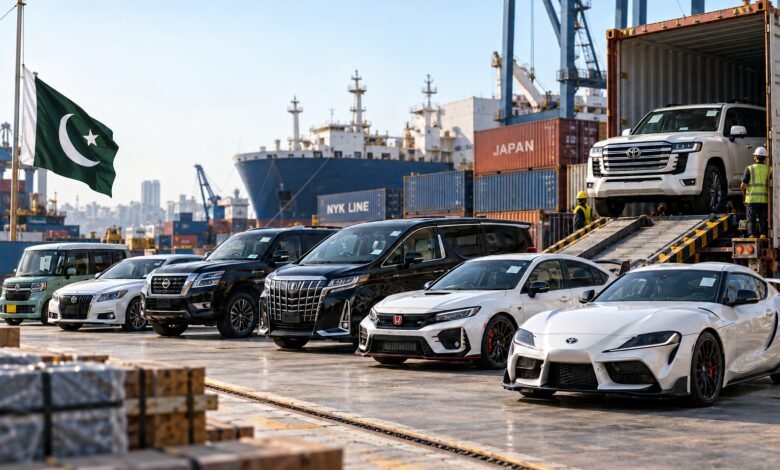
Islamabad: In a major development for the automotive sector, the Government of Pakistan has officially reopened commercial used car imports under a strict new regulatory framework. The Ministry of Industries & Production’s Engineering Development Board (EDB) issued a detailed policy notification on September 30, 2026, laying out tough new terms and conditions designed to end the era of unregulated, sub-standard, and accidental vehicle inflows.
The decision formally operationalizes earlier cabinet and Economic Coordination Committee (ECC) directives. By reopening commercial imports with these strict guardrails, the government aims to bridge the local supply gap while forcing all imported vehicles to align with UNECE’s WP-29 global safety standards.

Here is a breakdown of the key facts, the new legal requirements, and how this major reopening will impact local car buyers and the automotive market.
- Who is Allowed to Import? (Strict Eligibility Criteria)
To ensure only regulated entities operate in this newly reopened channel, the government is clamping down on gray-market operators. Moving forward, only properly registered corporate setups are allowed to commercially import used vehicles. To be eligible, an importer must be:
- A company incorporated under the Companies Act, 2017, a registered proprietorship, or a partnership firm.
- A holder of a valid Sales Tax Registration and National Tax Number (NTN/STN).
- An entity that explicitly lists vehicle import as its principal line of business.
- Mandatory Financial Traceability
To stop undocumented capital flight and illegal hundi/hawala channels, the reopened import facility mandates total financial transparency. Importers must execute all transactions exclusively through regular, official banking channels and maintain thorough, complete records of every imported vehicle. Furthermore, importers must have formal third-party agreements with FBR-registered workshops to guarantee after-sales services to local customers.
- The New “Pre-Shipment Inspection” Filter
Every single commercially imported used vehicle must now undergo a rigorous Pre-Shipment Inspection (PSI) before it ever leaves a foreign port.
- The inspection must be conducted by an internationally accredited body registered with the Pakistan Standards and Quality Control Authority (PSQA).
- The inspection certificate must explicitly guarantee that the vehicle complies with 62 specific UNECE WP-29 international regulations covering critical safety parameters (such as braking systems, seatbelt anchorages, door latches, child restraint ISOFIX systems, and impact protection).
- Zero Tolerance for Accidental or Meter-Tampered Cars
For years, local buyers have complained about unwittingly buying imported cars that were structurally damaged or had rolled-back mileage. The new notification hits this issue head-on. The official inspection certificate must explicitly certify that the vehicle:
- Has not been in an accident and features a clean exterior (no major bumps/dimples).
- Does not have a replaced or tampered odometer.
- Has a tidy, stain-free interior.
- Features a sound engine with exhaust emissions and noise levels well within permissible limits.
- Has completely intact windshields and window glass with no cracks or breakage.
- Is fully roadworthy and possesses the required number of operational airbags.
- Has a verified manufacturing date.
- Double-Checked at the Port (Post-Shipment Verification)
To prevent forged foreign certificates, a mandatory Post-Shipment document verification will occur once the vehicle arrives in Pakistan. A local representative of the same international PSI entity will verify the authenticity of the original certificate. Crucially, all costs for these pre- and post-shipment checks will be borne entirely by the importer, not the government.
What Does This Mean for the Pakistani Consumer?
- A Reopened Market with Higher Quality: The reopening of commercial imports will bring much-needed variety back to the local market. The biggest win for consumers is transparency. Buyers looking at popular imported hatchbacks or SUVs can finally demand certified proof that the car wasn’t written off in an overseas accident or tampered with before arriving in Pakistan.
- Potential Price Premiums: While imports are open again, they are no longer “easy.” Because these inspections are highly thorough, expensive, and require strictly formal banking procedures, many smaller showroom owners may struggle to adapt. The added cost of dual-stage testing and mandatory workshop affiliations will likely mean these newly imported used cars will carry a premium price tag.
- A Level Playing Field for Local Assemblers: By forcing imported used cars to meet stringent global safety guidelines (UNECE WP-29), the government is closing the regulatory gap between local car manufacturers and imports. This ensures fair competition while safeguarding local consumers.
Related News: