
What to Do If You Get a Flat Tire: A Complete Step-by-Step Guide
Learn how to safely handle a flat tire, identify the cause, replace it with a spare wheel or repair kit, and get back on the road with confidence.

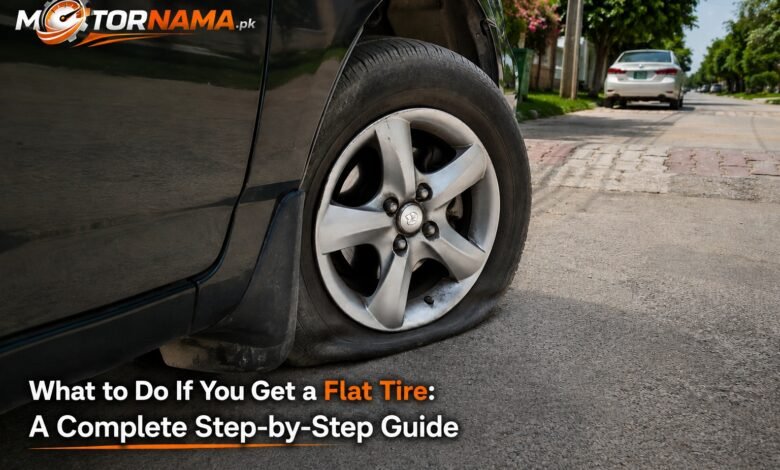
Imagine driving to work, finally heading out on that almost-delayed family trip, or heading out in an emergency, and your vehicle starts pulling to one side, or starts to rumble very loudly. The steering starts to feel heavy, or you hear a rhythmic thumping sound from one of the tires. All of these are signs that you have a flat tire, and it is time to get your hands dirty and change it. A flat tire is one of the most common issues while driving a vehicle on the road. Pakistani road infrastructure is not very good, and even if you are living in a posh area, chances are that there is at least one pothole in the area which everyone calls a tire buster.
If you do get a flat tire, it does not have to become dangerous unless you are at high speeds. Even at high speeds, a flat tire can be controlled with the right strategy and a calm mind. You must know what needs to be done if you get a flat tire in order to keep yourself safe, avoid unnecessary damage to the vehicle, and get back on the road as soon as possible without losing your confidence. While generally, a lot of Pakistanis know exactly how to change a tire in case of a flat one, if you are one of those who do not know what needs to be done with a flat tire, this guide is for you. This guide explains what exactly you need to do when you get a flat tire, whether in the city, on the motorway, or in a rural area.


How to Tell If You Have a Flat Tire
While it may sound daunting, it is actually pretty easy to tell if you have a flat tire. Before heading somewhere, you should make a habit of checking all tires once. Start the car, get out, walk all around the car, and inspect all four tires and the surroundings, and then start driving. This will give you a general idea that all tires have the same pressure.
Once you start driving, there are also some ways by which you can easily tell if one of your tires has less air or just got a puncture.
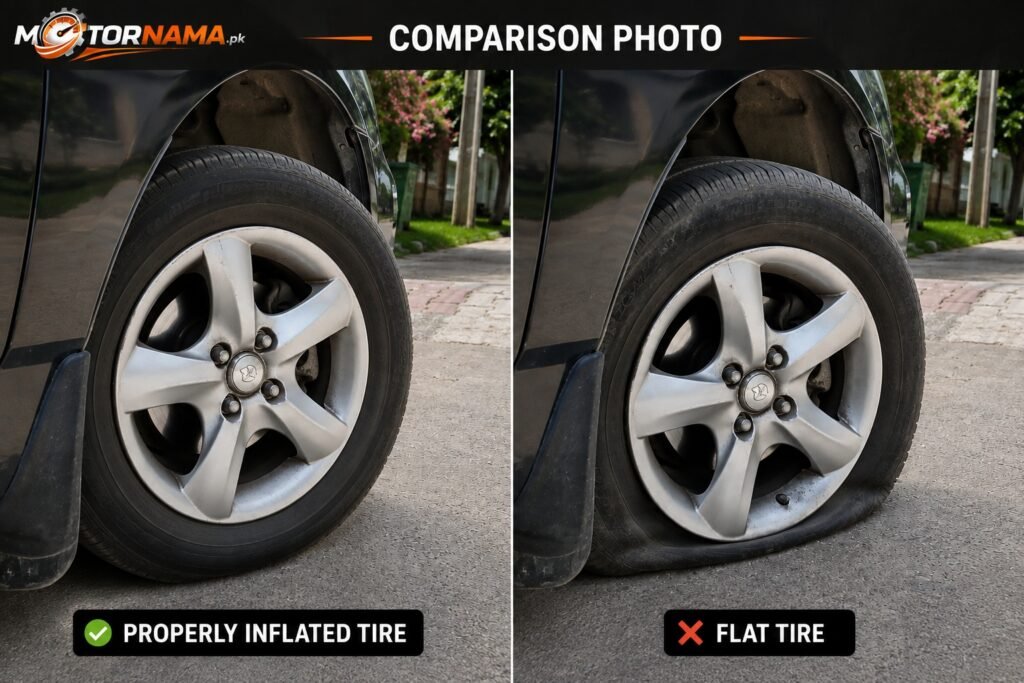
You will instantly know if a tire is losing air because it will be deflated and will appear flatter than the rest of the tires.
When the air in a tire comes out or is very low, the tire is deflated and thus takes up more space than a fully inflated tire. This means more surface area comes in contact with the surface, and it takes more effort by the engine to move it. This also makes the steering heavy even with power steering if it is a front tire.
If while driving, you suddenly feel that the steering wheel has become very heavy, one of your front tires has punctured. In some cases, the vehicle will start pulling to one side too. You will try to drive in a straight line, but the steering wheel will be constantly fighting you to go against the straight line.
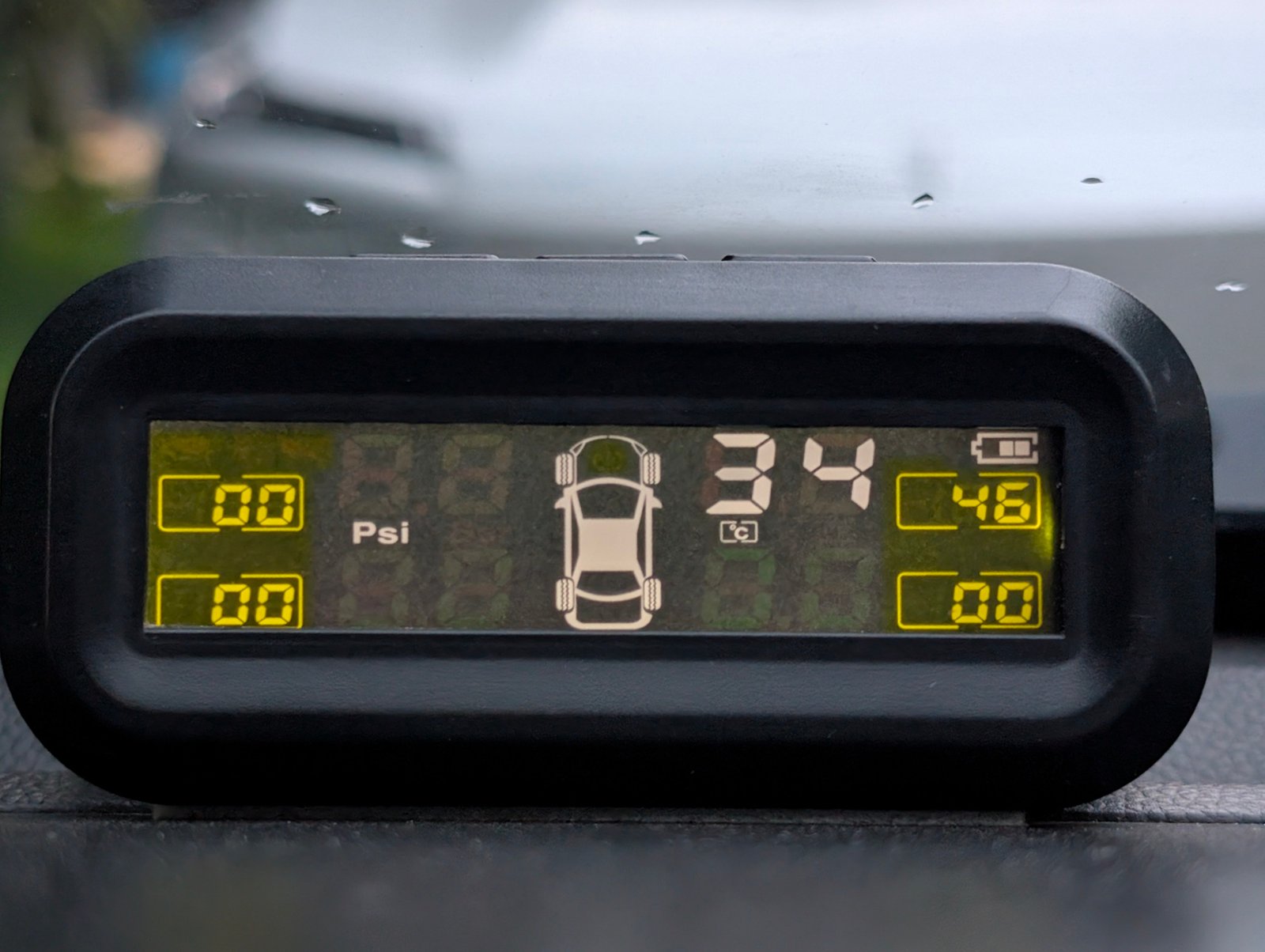
If your vehicle comes equipped with a Warning Light, such as in a Tire Pressure Monitoring System, it will notify you instantly when a tire is flat. It will also notify you if the air pressure in any tire is below the default setting. Another telltale sign of a flat tire is a rhythmic thumping sound coming from the wheels. Since the punctured tire is flat and unable to absorb bumps or obstacles, it will instead start making a thumping sound.
If your parked car has a puncture, it will be lower on one side due to the tire size difference, and it is very easy to spot. In extreme cases, you will also notice a visible difference in the vehicle’s acceleration as well because the engine will need more power to reach normal speeds.
Flat Tire Emergency Checklist
✓ Hold the steering wheel firmly.
✓ Ease off the accelerator.
✓ Avoid sudden braking.
✓ Turn on the hazard lights.
✓ Pull over to a safe location.
✓ Inspect the tire before deciding what to do next.
Step 1: Stay Calm and Don’t Slam the Brakes Instantly
The very first step if you have a punctured tire is to stay calm and do not make any irrational movements with the steering wheel. Never, ever slam the brakes because it will cause the vehicle to lose traction, hit the curb, and even flip over if you are at high speeds. What you should do instead is hold the steering wheel firmly and ease off the accelerator. Avoid giving the car any more gas. The vehicle will quickly lose speed due to increased friction from the punctured tire.
Avoid turning the steering wheel left or right quickly; instead, gently turn the wheel to give the vehicle plenty of space to change lanes, and then aim for the side of the road. Brake gently if you see something ahead, but never brake too harshly. Keep control of not just the vehicle but also yourself. Remaining calm is crucial in this situation because if you panic, you may cause an accident.
Step 2: Find a Safe Place to Stop
Once you have control over your vehicle, the next step is to find a safe spot to stop in order to assess the damage to the tire. Since you might need to change the tire, ensure that you look for a wide shoulder to park if you are on a highway or motorway. The wide shoulder is a special place for vehicles to park in case of emergencies and breakdowns. This will have enough space for you to move around the vehicle to change the tire if it comes to that. Other good spaces could be parking lots, petrol pumps, or other open spaces that are a little off the main roads and have less traffic.
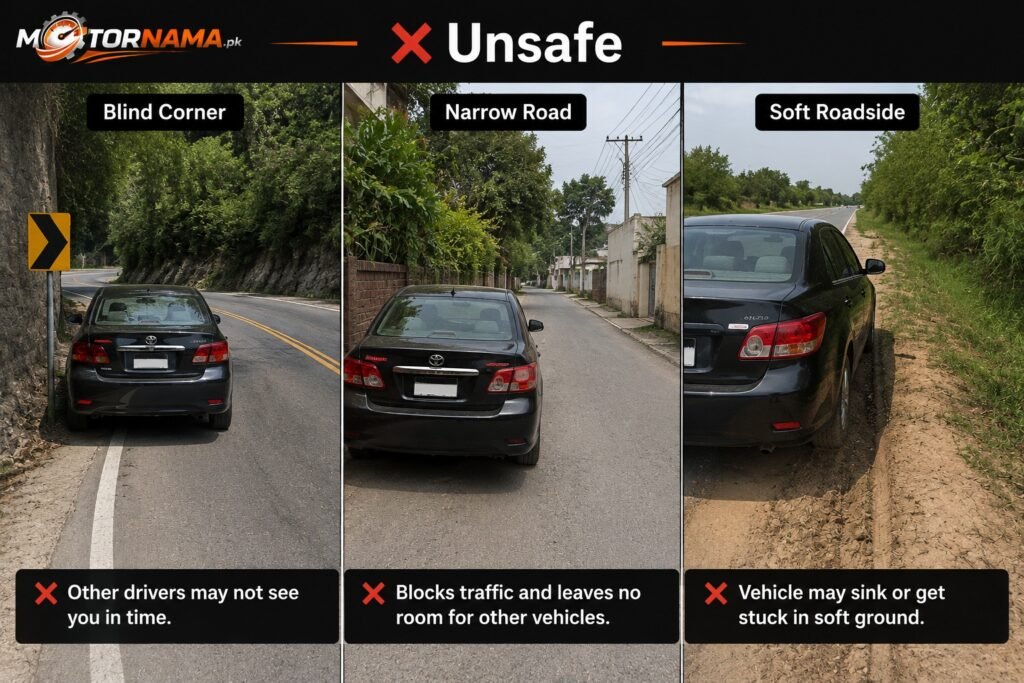
Avoid stopping in places like blind bends or sharp corners where the approaching vehicle might not be able to see you in time to slow down or stop. Also avoid right after the crest of a hill when the incoming traffic is unable to see the road ahead. Never stop in the middle of a busy road or motorway because someone will be distracted enough to hit you or your vehicle. If you find a space to park, make sure it does not have soft ground, loose gravel, or mud because it will make it hard to change the tire since the vehicle will not find traction to stop once you lift it using the vehicle jack.
Many roads in Pakistan, especially in cities and rural areas, don’t have a proper emergency shoulder. If there isn’t enough space to stop safely, continue driving slowly with your hazard lights on until you reach a wider, safer location. Driving a short distance at low speed is generally safer than stopping in a dangerous spot where passing traffic could put you at risk. You often see people parked in the middle of roads trying to change tires or fixing the engines, but this is a very high risk and must be avoided at all costs if you value your own and others’ lives.
Step 3: Turn on Your Hazard Lights
Once you find a parking spot that is safe, the next step is to turn on your hazard lights or what is generally known in Pakistan as ‘double indicator’. Press the button which is red in color and has two white triangles in it. Its location will vary depending on your vehicle model, but it will be visible clearly on the dashboard. It is mostly located between the front two AC vents. Press it once, and both of your car indicators will start blinking at the same time.
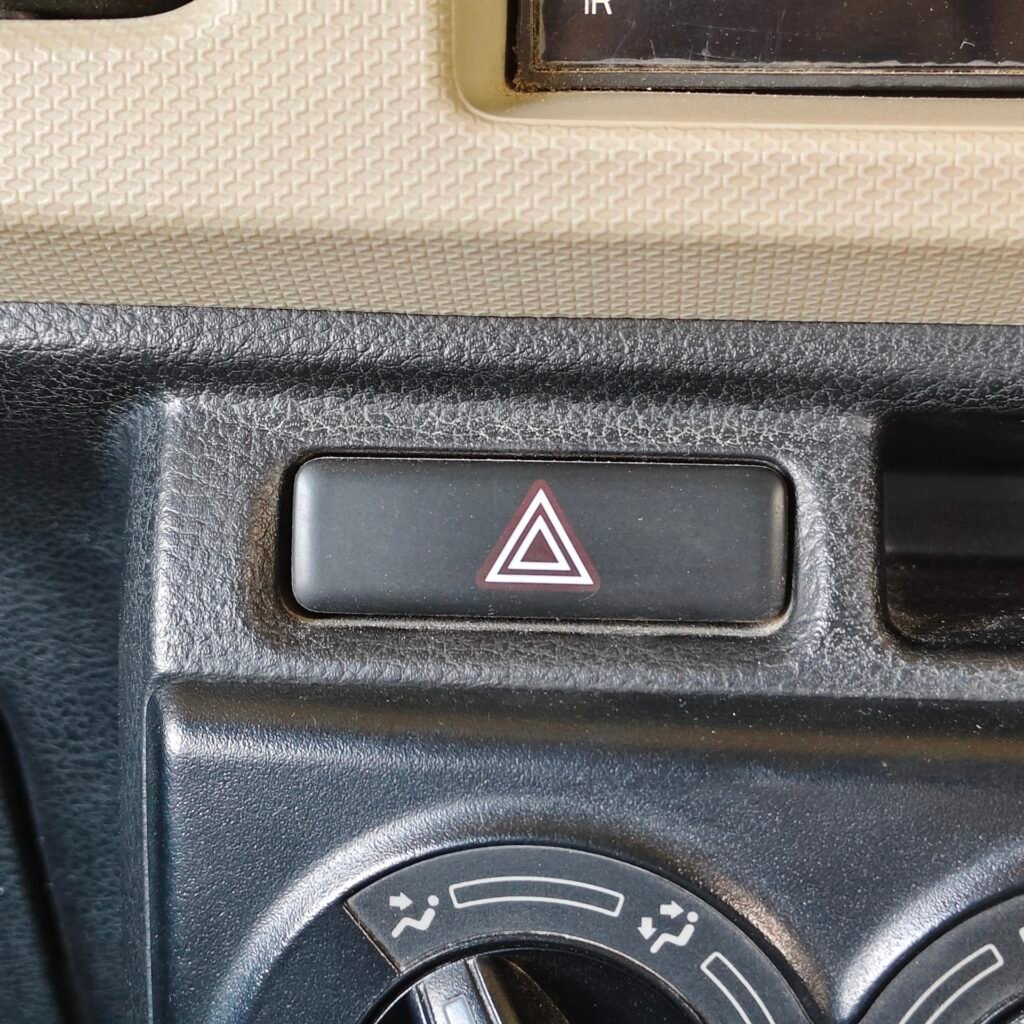
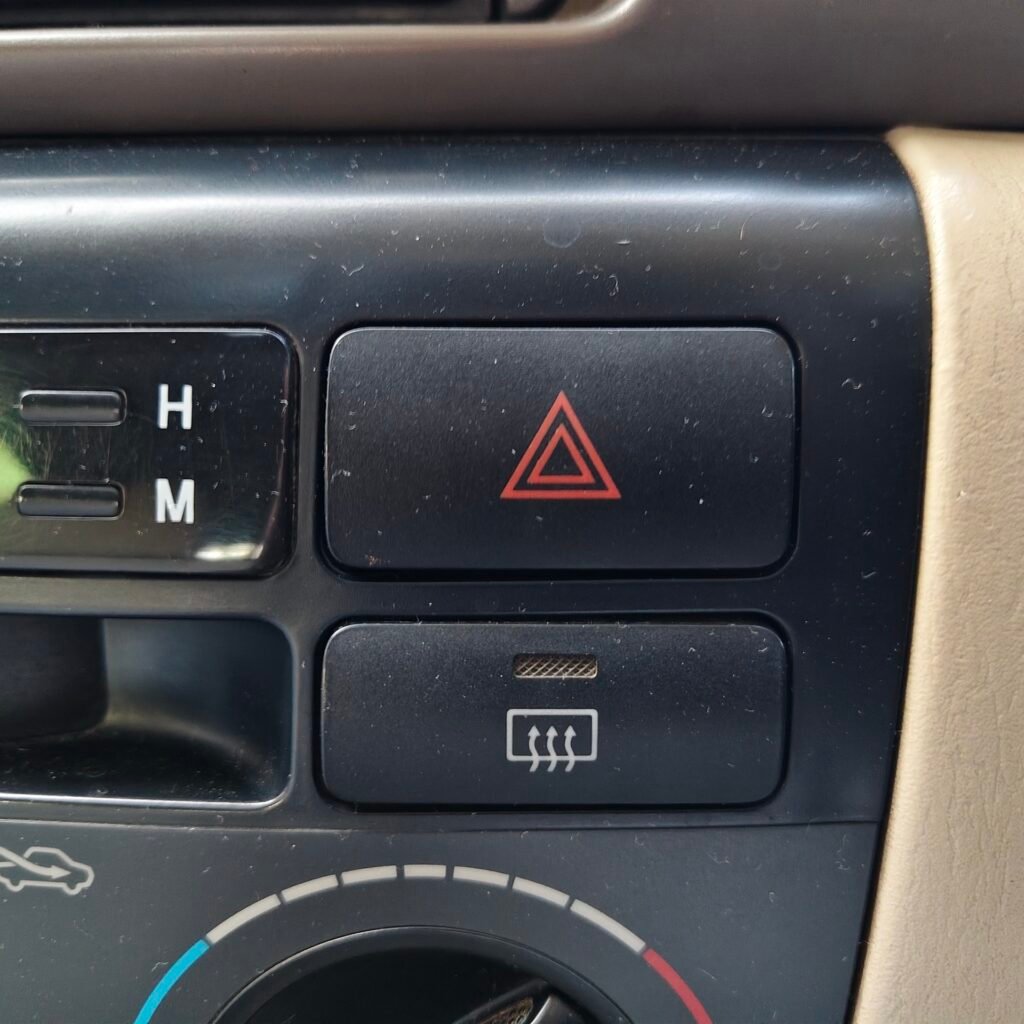
While it is generally not followed in Pakistan, having a reflective vest on your vehicle along with a charged flashlight is very important because if you break down during the night, these two things will help you massively. Not only will the flashlight help you look around easily, but the reflective vest will inform incoming vehicles of your presence on the road from afar. If you have traffic cones or a warning sign in your trunk, place it behind your vehicle at a decent distance.
Step 4: Inspect the Tire
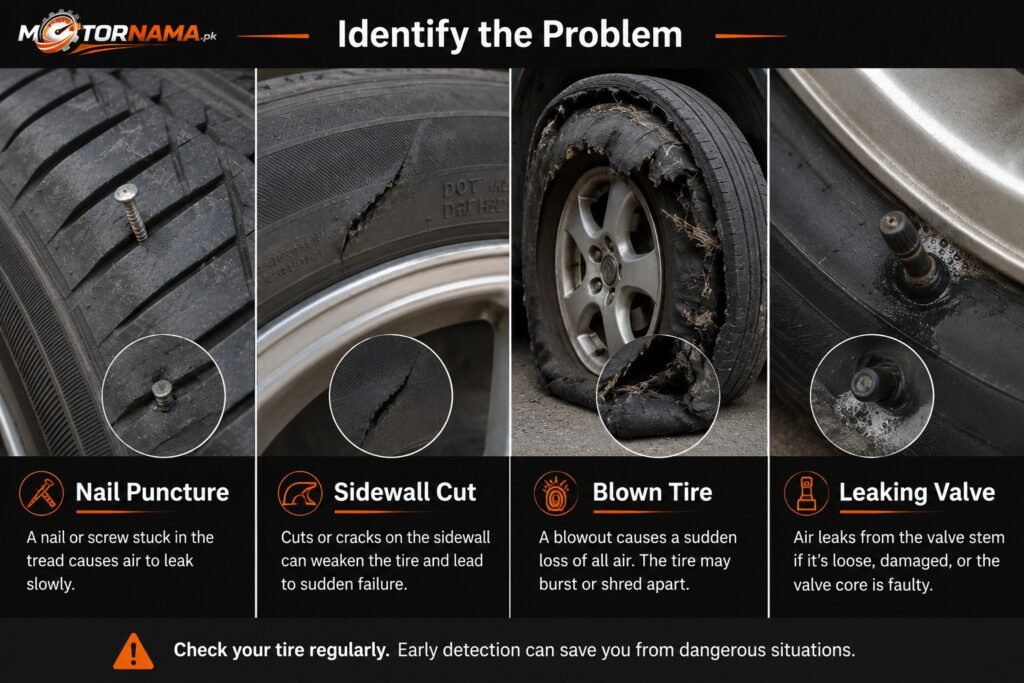
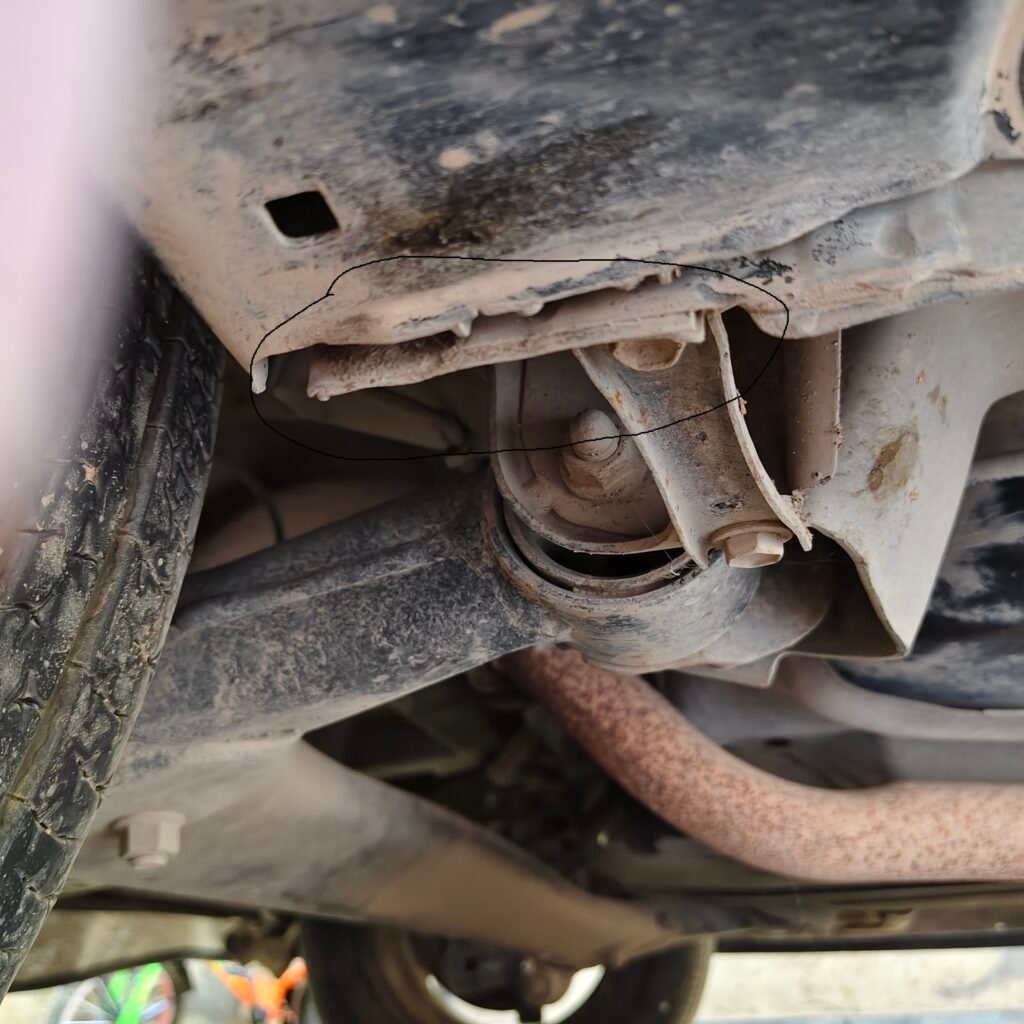
The next step is inspecting the tire, and it is very important because it will determine your next course of action. You will need to visually inspect the tire and look for the cause of the puncture. Use your hands to feel around its surface and check for any nails or screws in it. Look for any cuts along the sidewalls and check the nozzle to see if it is leaking. If you suffered from a blowout, check how much damage the tire has, and whether it damaged any of the suspension components or joints near it, including the body panels. Determine whether the leak is slow or rapid.
Can You Drive With a Flat Tire?
Accessing the damage will give you an idea whether you can drive further with the flat tire or not. Normally, a nail or screw that remains inside the tire blocks the air from coming out and will be safe to drive until you come to a tire shop. Similarly, if you have a sidewall cut, smaller cuts will have reduced airflow coming out, so they will give you enough time to drive to a tire shop to get it repaired.
Since you are stopping on the side because of the tire going completely flat, chances are that you are out of options. Never drive with a flat tire because it will not only damage the tire and rim itself, but also suspension components. On motorways and highways, you can also experience loss of control, so it is never safe to drive with a flat tire. Before moving on, you must remedy the puncture.
Step 5: Gather Your Tools
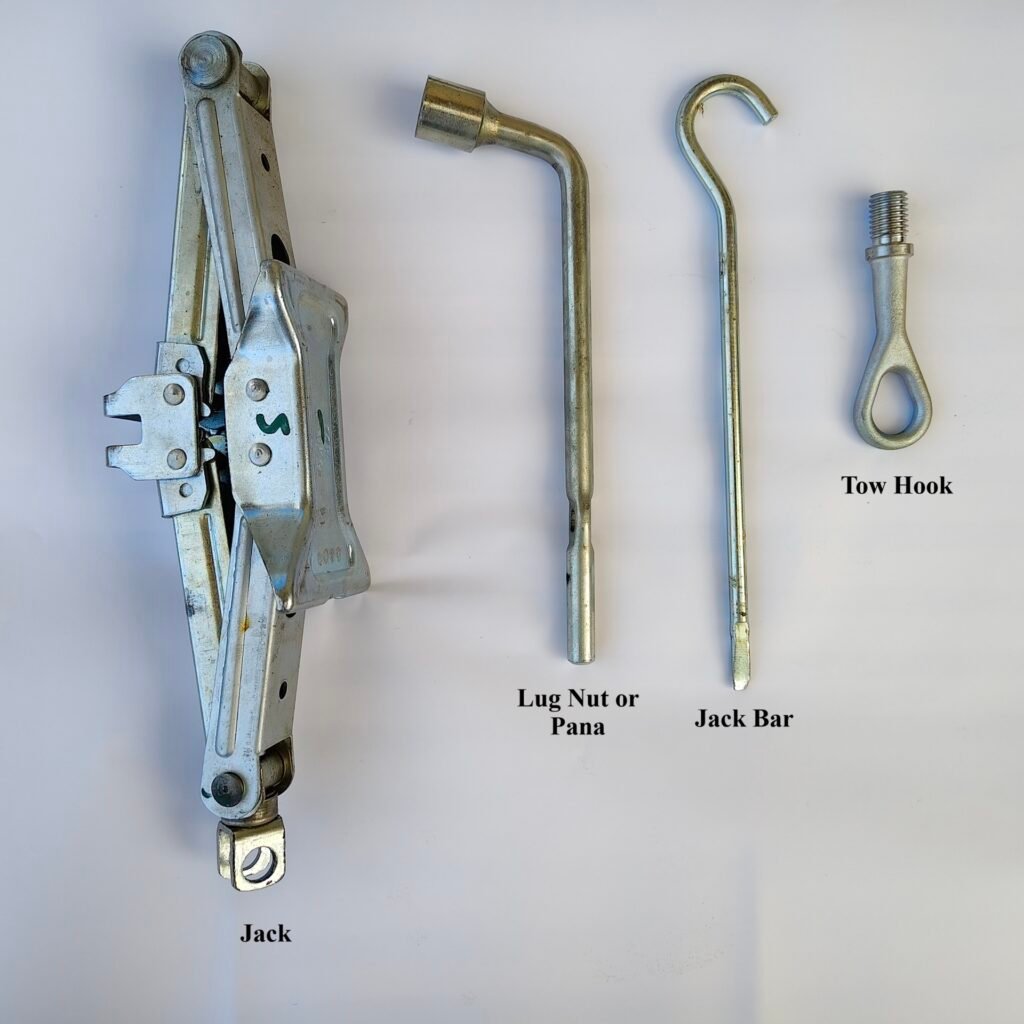
In order to change the tire, you will now need to gather all of the tools. Open the trunk, and inside the trunk, you will find a covering. Remove the covering, and you will find your spare tire or ‘stupni’ that we call it in desi terms, along with some tools that are used for changing the tire. These will include:
- Spare Wheel (stupni)
- Jack
- Lug Wrench (pana)
- Wheel Chocks
- Gloves
- Torch
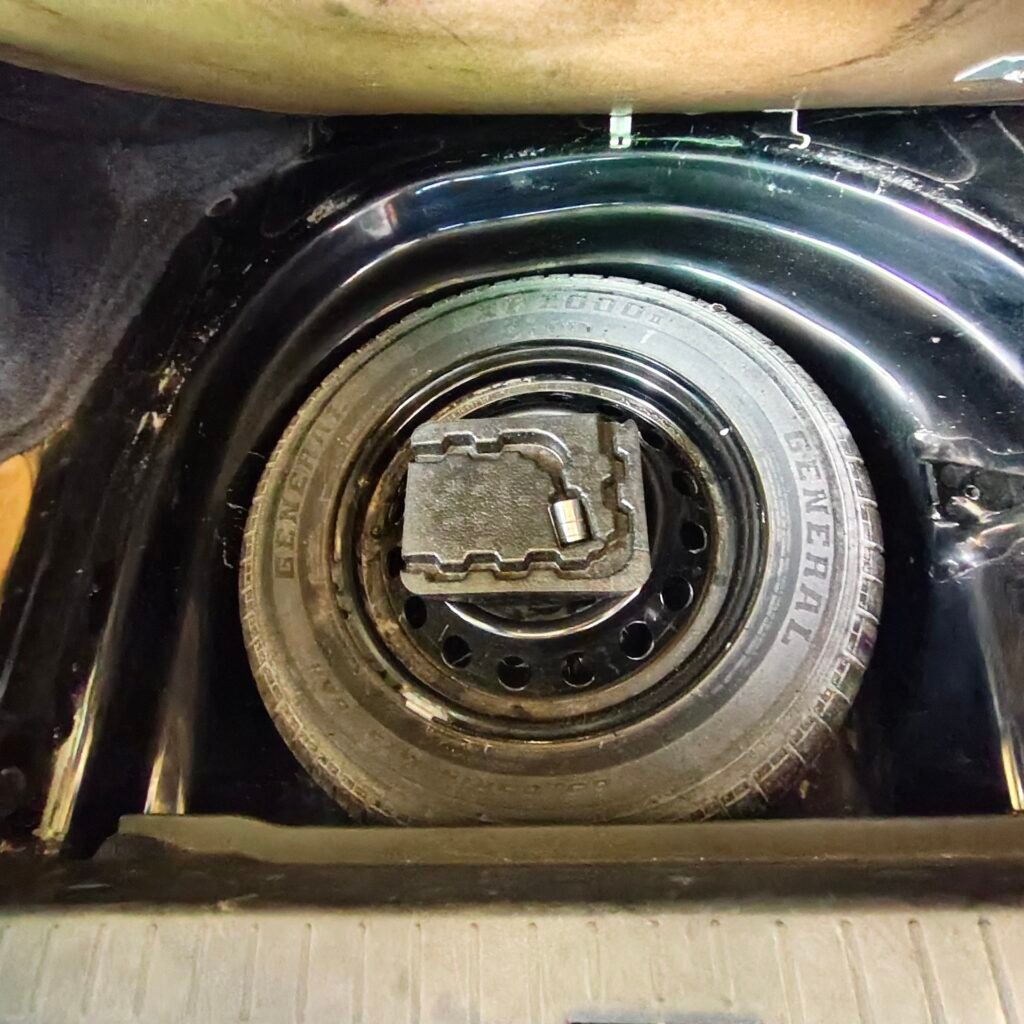
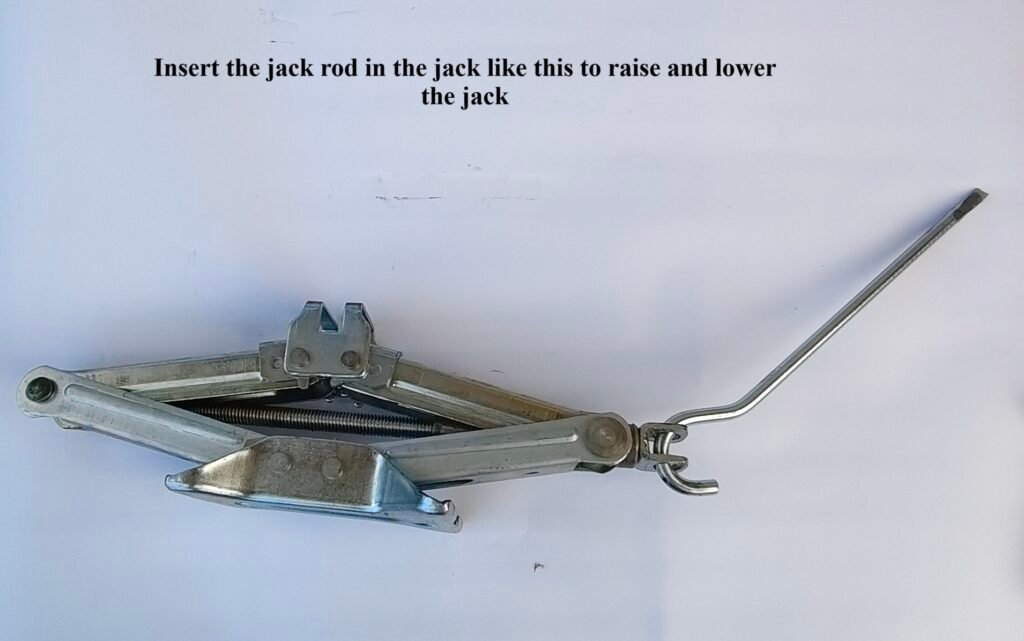
At the time of delivery, every new car comes with a spare wheel, a jack, and a lug wrench. The jack can be automatic or manual, and if it is manual, it will have its own handle along with it as well, which will allow you to lift and drop the jack. I will suggest that you keep wheel chocks, gloves, and a torch in the car for situations like this. Once you have all of your tools gathered, it is time to change the tire.
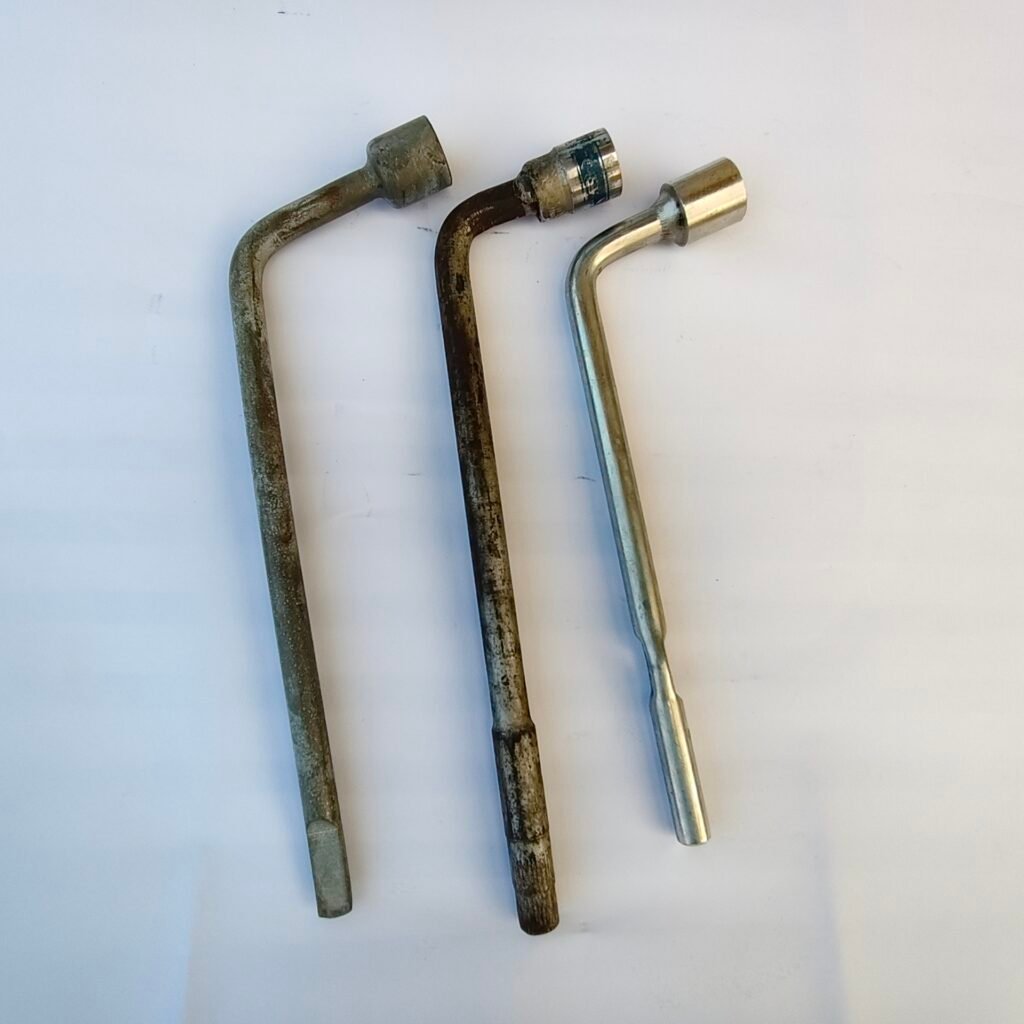
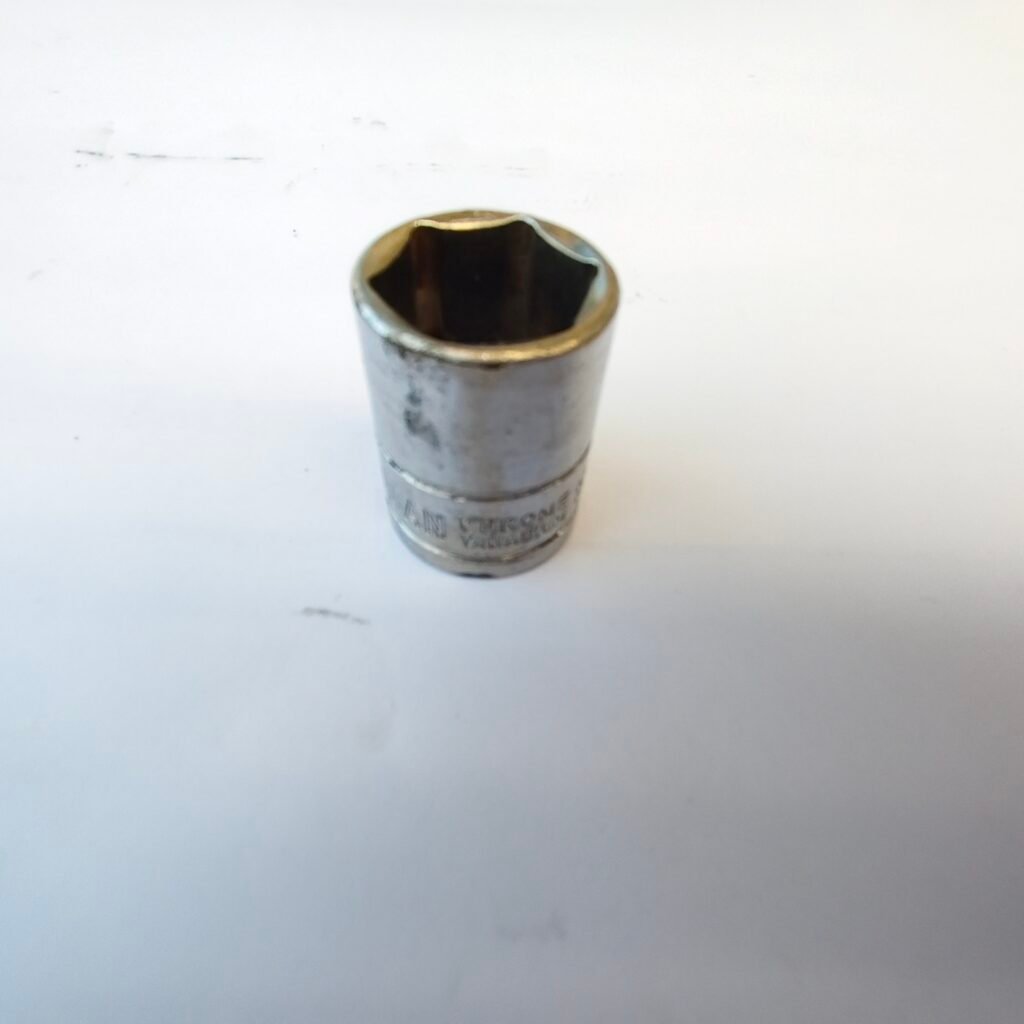
One important note I will mention here is that if you are using aftermarket rims and lugs, your factory lug wrench might not be able to fit in them, and you will not be able to open up the aftermarket lugs with it. For them, make sure that you always carry their correct size plug or ‘goti’ in desi terms, which will fit in your factory lug wrench, and then it will fit in your wheel’s lugs. If you are using aftermarket rims and lugs, make sure that you always have the correct ‘goti’ with your tire tools.
Step 6: How to Change a Flat Tire
Now to the main thing: you will need to follow some simple steps before removing the wheel and changing it.
Engage the Parking Brake:
First, go back inside the vehicle and ensure that the vehicle is in the parking gear and the handbrake or parking brake is engaged. This will prevent the vehicle from rolling forward or backward. If you are changing the front tire, engage the handbrake since it locks the rear wheels. If you are changing the rear wheel, put the vehicle in its 1st gear, but make sure that the vehicle is turned off. This will lock the front wheels, and it will not move forward. For automatic vehicles, always keep it in P. Certain vehicles do not have P, and they instead have N. N is for neutral, and the vehicle can still roll in N. Make sure to engage the parking brake in such automatic vehicles.
Place Vehicle Chocks:
Next up, you have to block the tires so that the vehicle does not roll away in case of a mechanical failure. If you do not have wheel chocks, find a large stone or brick, and place it on the opposite-side tire. For example, if you are changing the right-front tire, the brick goes on the back side of the back-left tire. For changing the front tires, put the brick on the back side of the tire. For changing the rear tires, put the brick on the front side of the tire. This will prevent the vehicle from rolling in the opposite direction if the vehicle comes out of gear suddenly or if the handbrake fails.
Loosen Wheel Nuts:
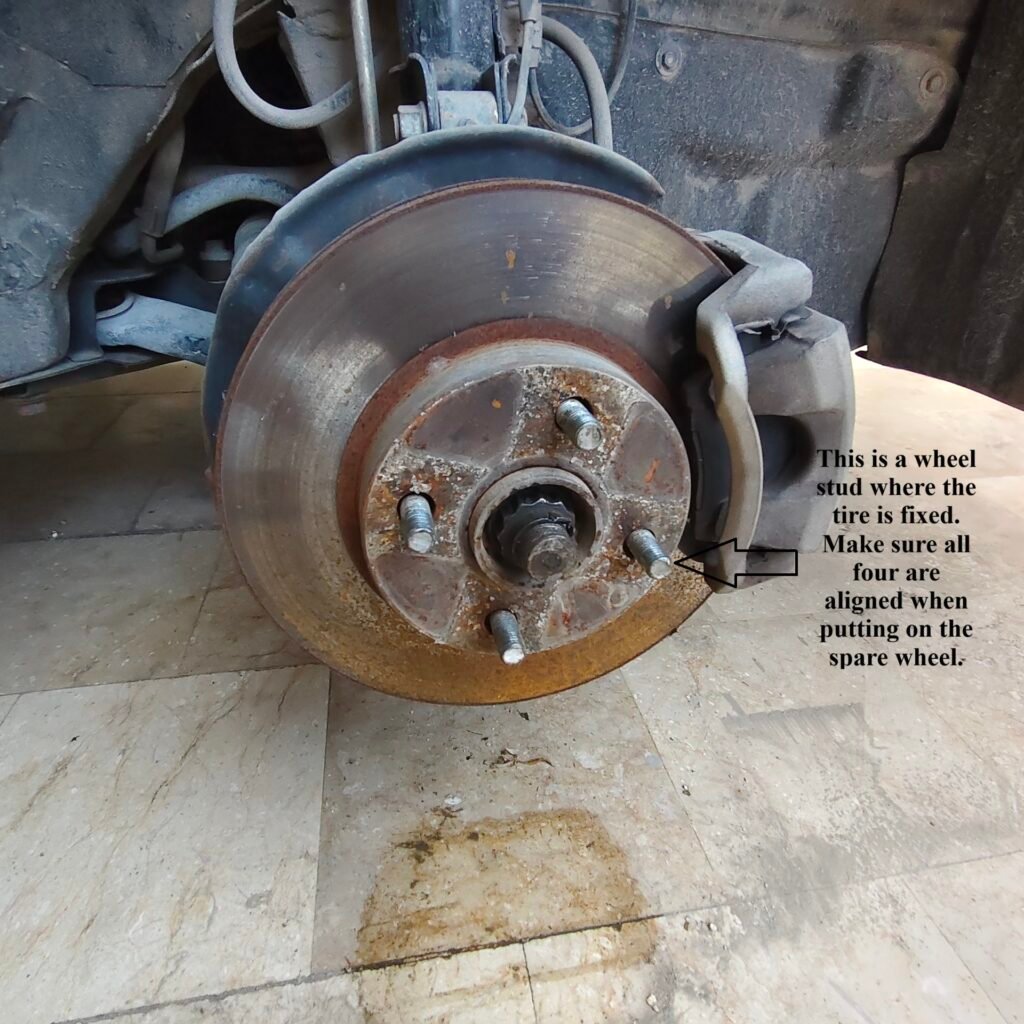
Before lifting the vehicle, make sure that you loosen the wheel nuts or lugs, whatever you want to call them. These are either four or five screws that tighten the wheel to the wheel hub. The wheel hub is the central metal part, usually black or silver in color, where the long wheel studs are attached, on which the wheel sits. The wheel nuts are what hold the wheel secured on the wheel studs, which are in turn attached to the wheel hub.
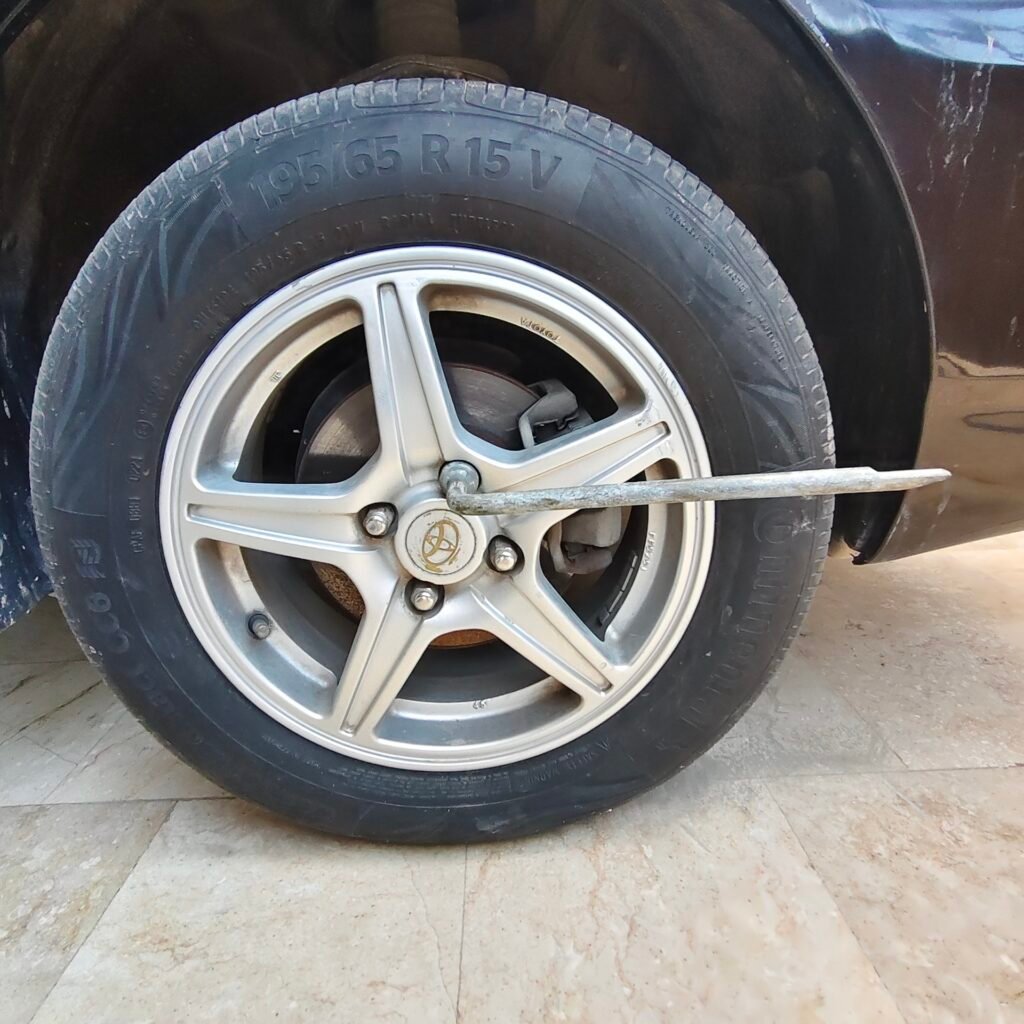
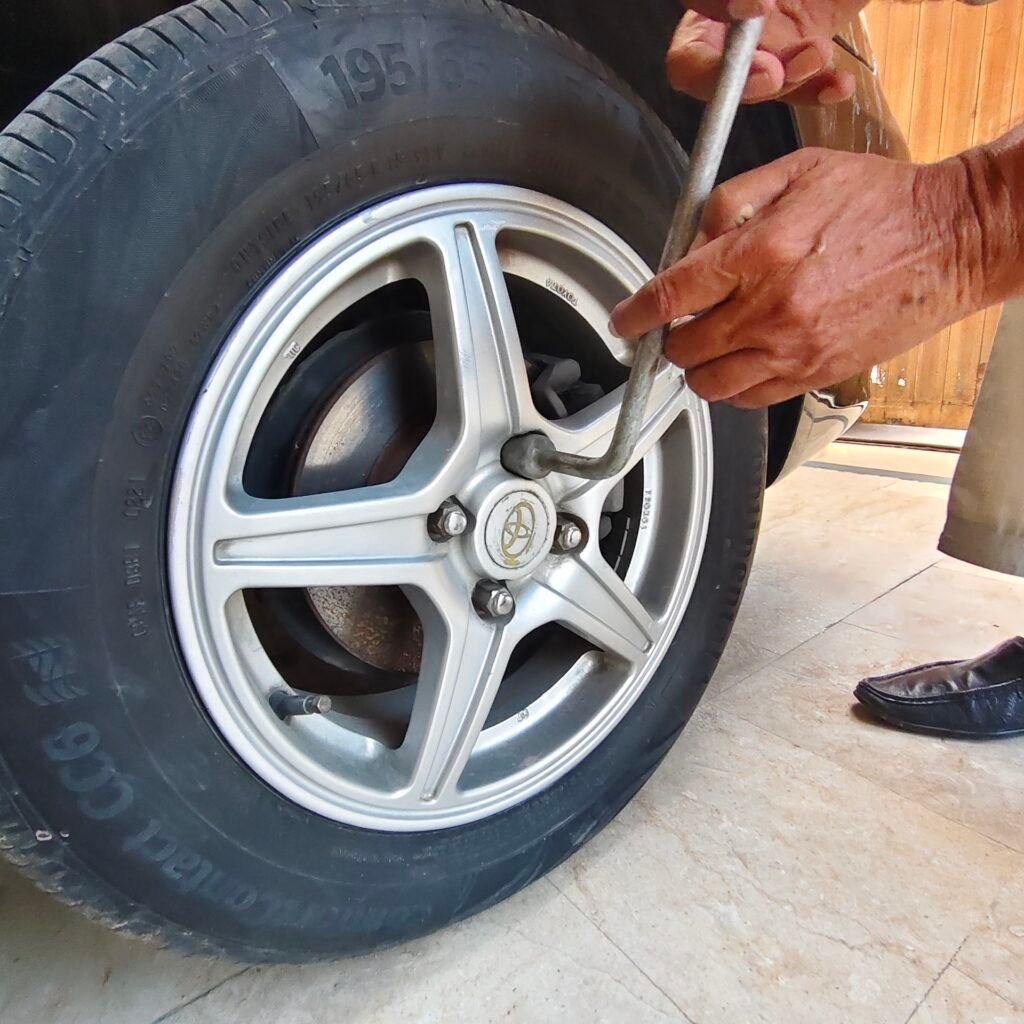
To loosen the wheel nuts, you will use the lug wrench or any further goti if you have aftermarket nuts. Place the wrench and then use your hand to ensure that the wrench is locked in position. Before exerting force by hand, I suggest that you use your leg to put force on the wrench so that it loosens easily. Make sure you are careful, because this can cause injury as well. Loosen all four nuts, and once they can be rotated by hand, move to the next step.
Position Jack Correctly:
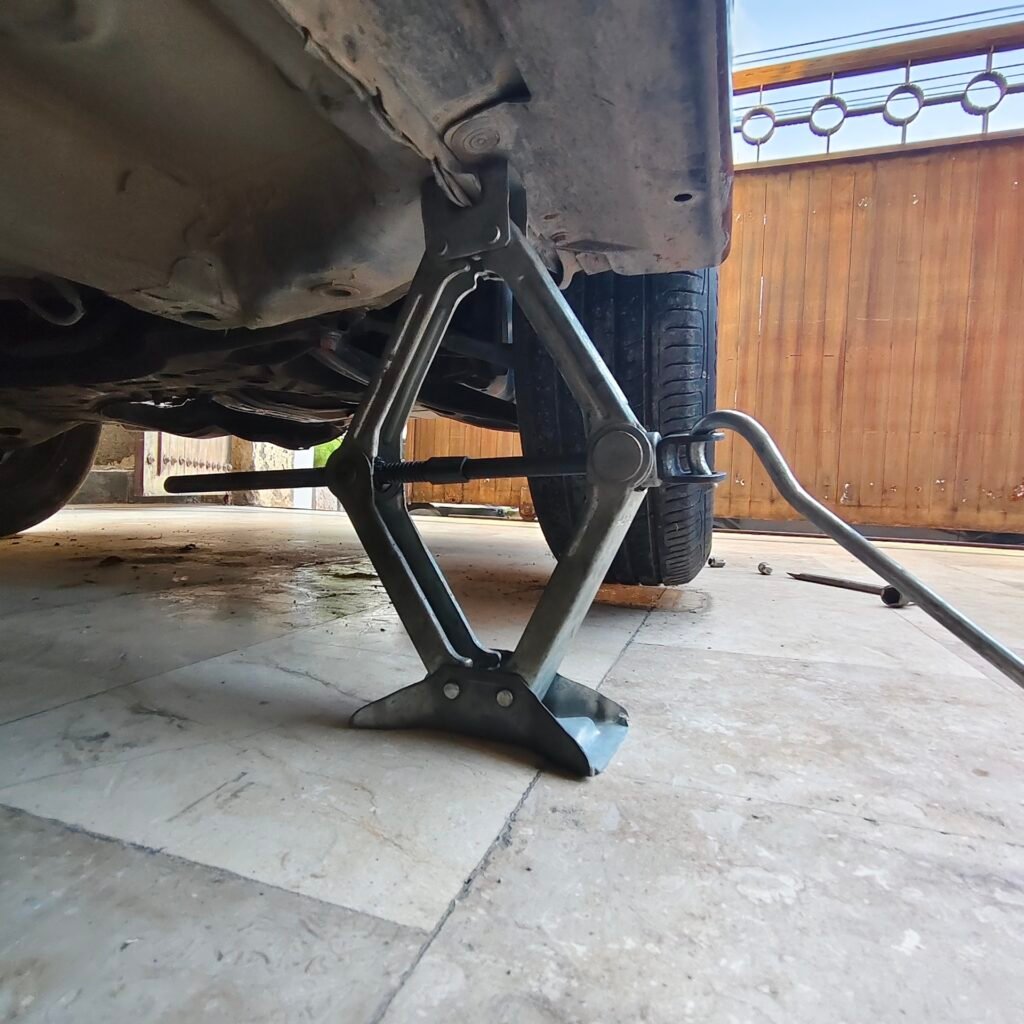
The next step is very important because the jack needs steady ground and the proper mounting location so that it can lift the vehicle without damaging it. An improperly placed jack can not only become loose, making the car fall down and damaging components, but it can also crush any person’s hands, arms, and legs that might be under the car. You must place the jack in the correct spots.
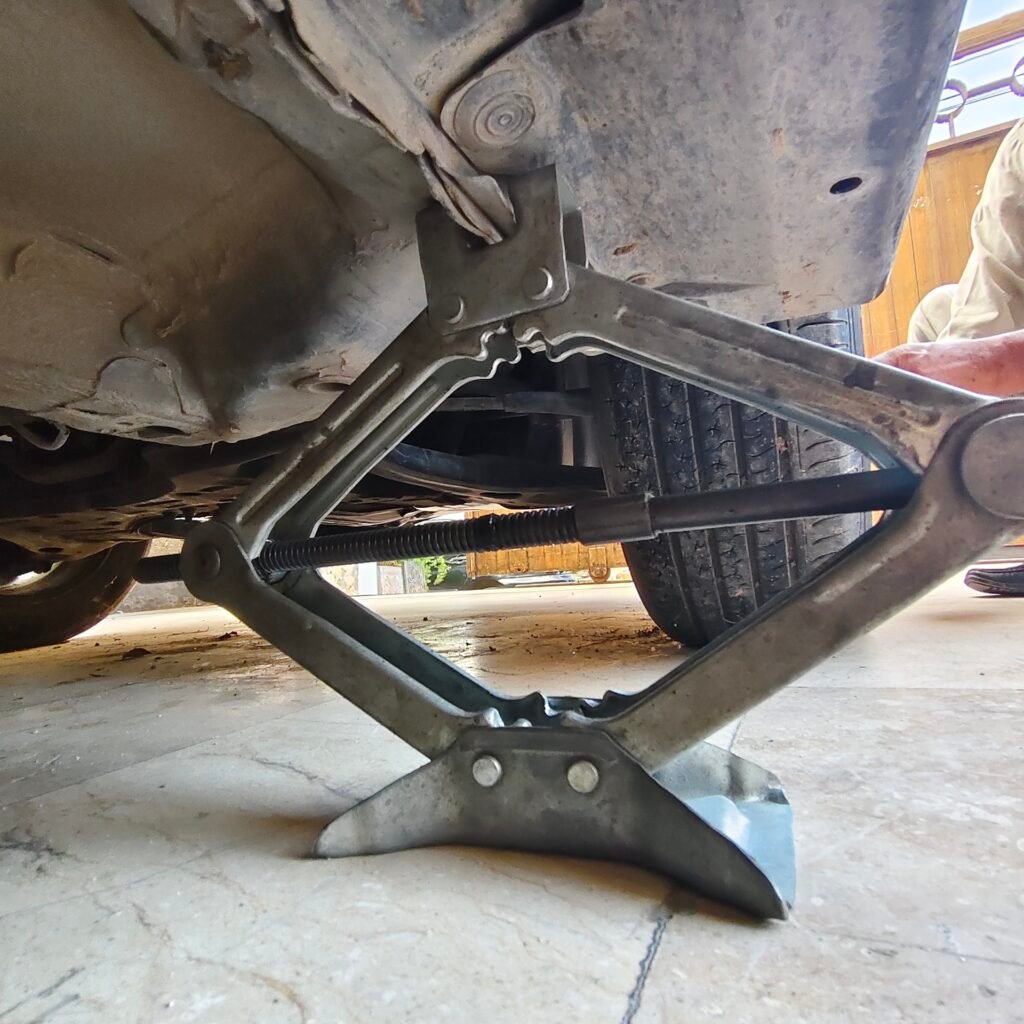
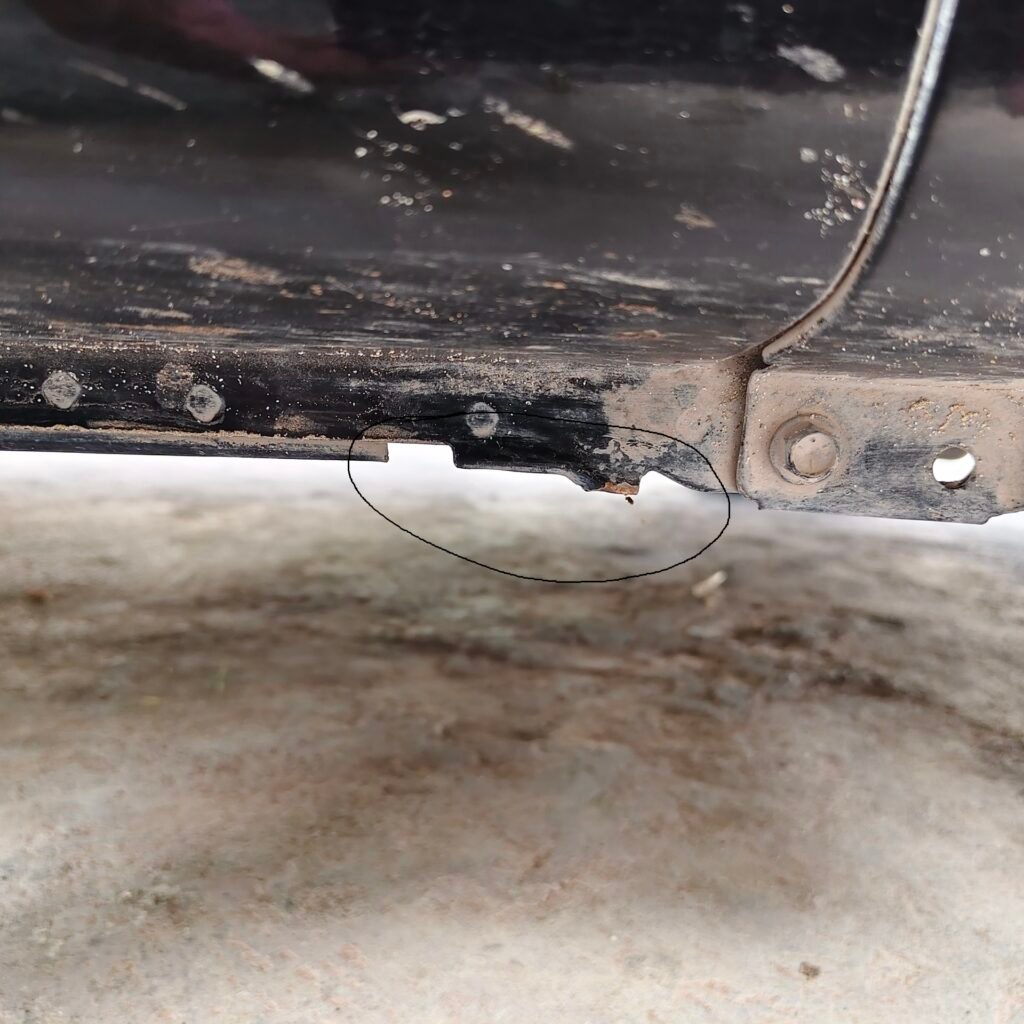
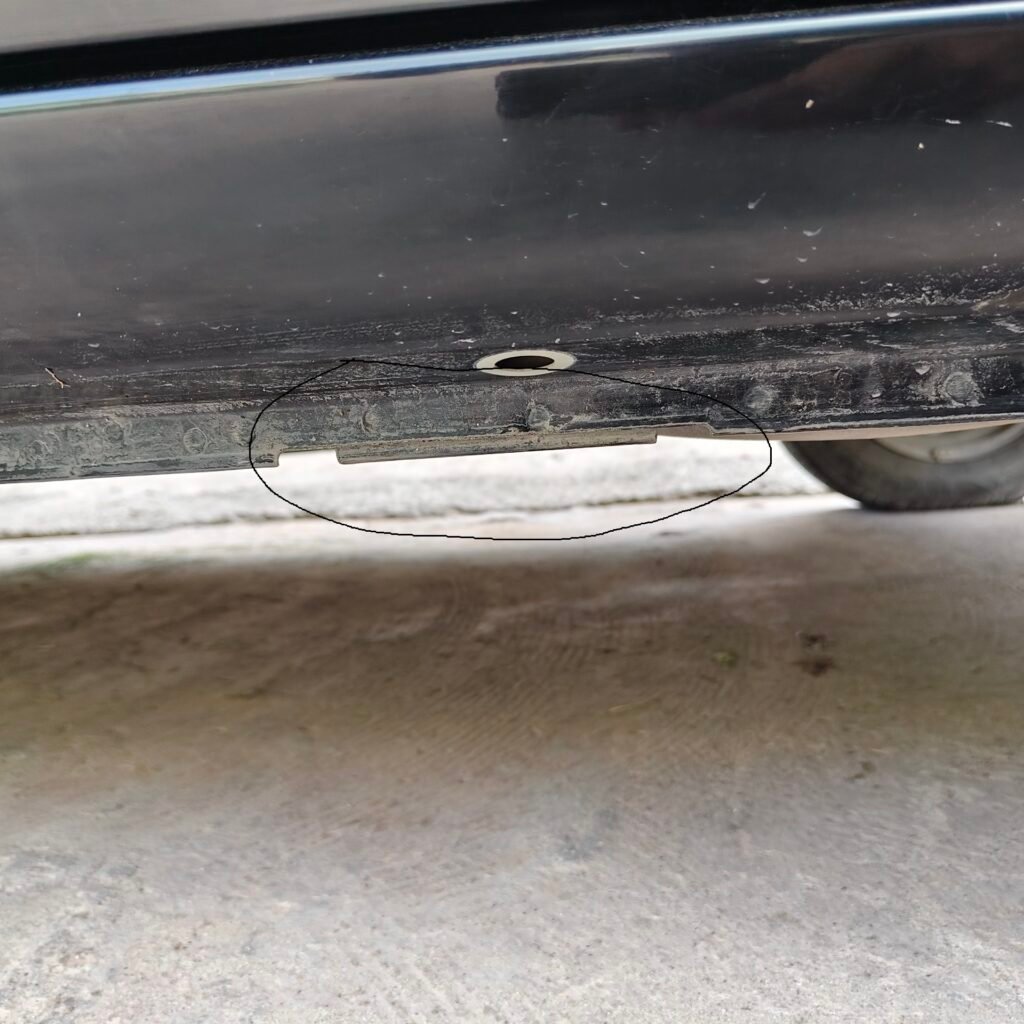
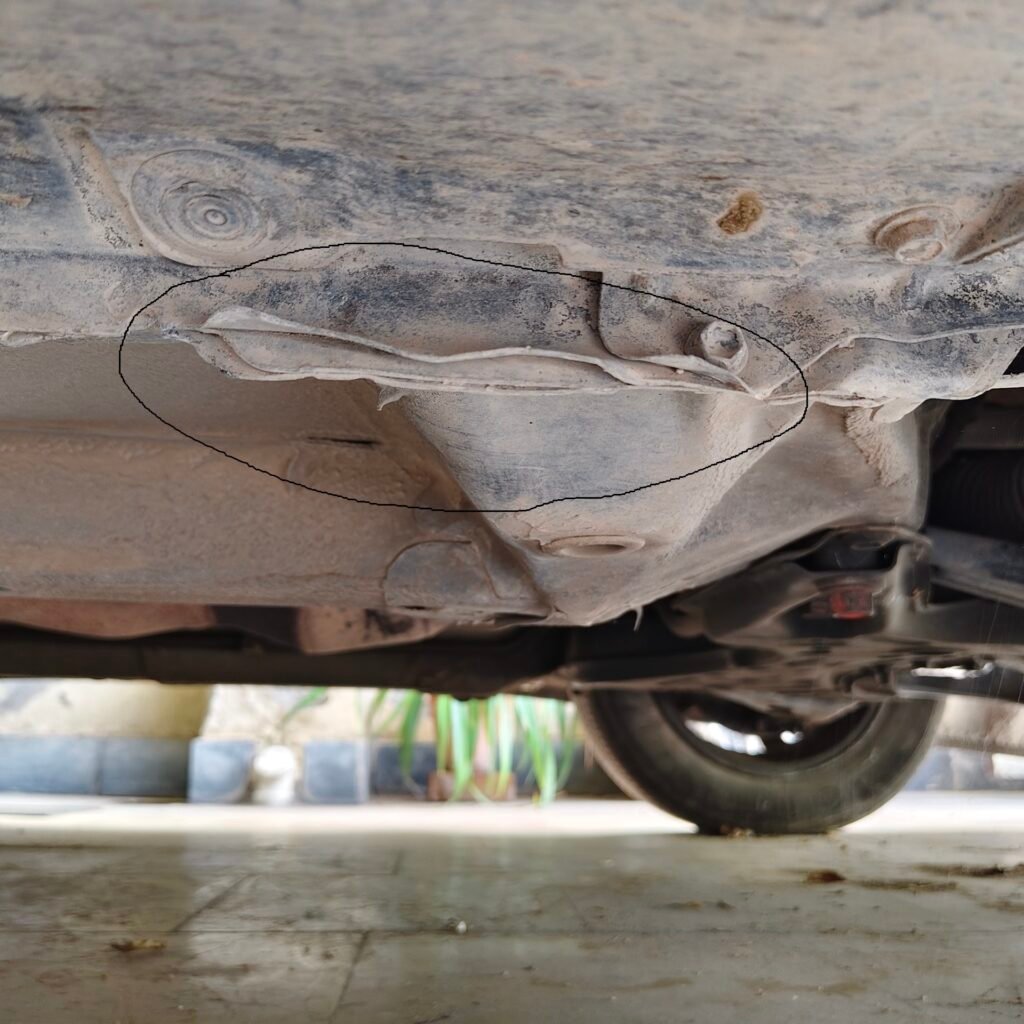
On the bottom of every car, every manufacturer leaves two jack points near every wheel of the vehicle. You can either feel them using your hands or bend down and look for them. They will look like teeth. This is the space where the top part of the jack will be inserted, and then you can just lift the car. Depending on your jack type, you will either lift automatically or manually.
Remove the Wheel and Insert the Spare
Once the nuts are loose and the vehicle is lifted, you can easily take the wheel off.
To do so, remove the screws and pull out the vehicle. It will be a little heavy, so make sure that you are prepared to lift it off properly. Once the wheel is out, simply put it anywhere safe, and grab the spare wheel. Align the nut holes with the wheel studs and insert the wheel into them. Keep your hand on the wheel and put the nuts back one by one until all of them are in place.
Keep rotating the nuts until you can do so with your hand. Do not use the lug wrench at this point. Make sure the wheel is inserted all the way inside, and all holes are properly aligned with the studs. Push the wheel once to make sure that no nut is looser than the other one. Once you have manually tightened the screws, grab the wheel at opposite ends and try to take it out. It should be firmly in place. If there is any play, check the lug nuts again because one or two of them are not properly tightened or the wheel is not aligned properly.
Lower the Vehicle:
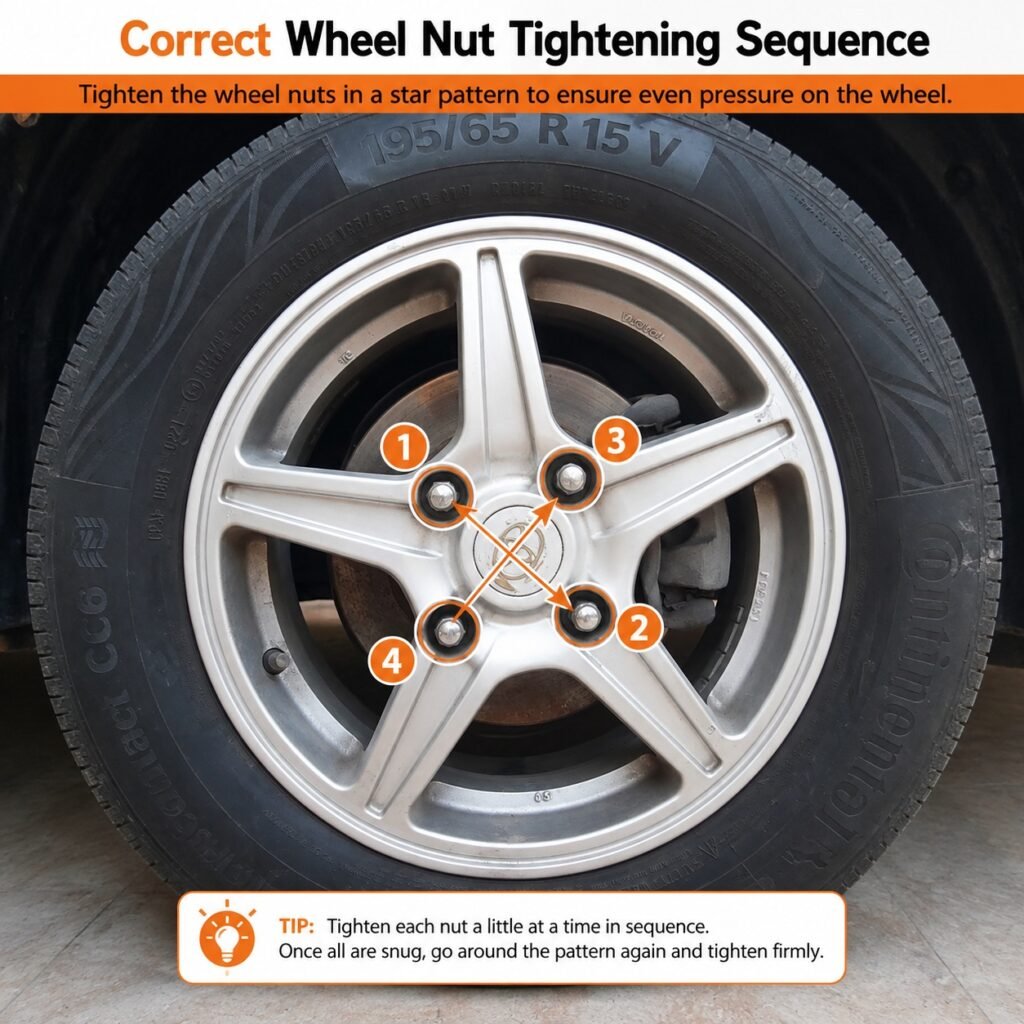
Once the spare wheel is in place, you can now lower the vehicle. Lower the jack and let the vehicle put its weight on the wheel. Let it come down slowly and listen closely to any sounds coming from the wheel. Normally, if the wheel is loose, it will move around with a loud thud as the vehicle’s weight comes on it. If nothing happens, lower it all the way and pull the jack and tools away from the vehicle. Now it is time to tighten the screws once again. Use the lug wrench and tighten the nuts one by one in a star formation.
How Tight Should Wheel Nuts Be?
For tightening the wheels, you should always go for the star formation. This pattern ensures that even pressure is distributed across the wheel and prevents the wheel or the brake rotor from warping under pressure. You should avoid tightening the wheels in a circular method, counterclockwise or clockwise, because it can damage both the wheel and the brake rotor.
If you have a torque wrench, avoid tightening the wheel with it unless the tire has been repaired because most tire shops in Pakistan work manually, and sometimes the torque wrench may cause locally made nuts to slip. Wait until the tire is repaired and back in its place before tightening it with a torque wrench. Once the wheel is tightened and you are travelling on a highway or motorway, check again after at least 50 KMs to ensure that the wheel is securely in place and no nut has come off or is loose.
When You Should NOT Change the Tire Yourself
While a tire puncture may make you think that you should immediately change to a spare wheel, there are certain conditions when you should NEVER change the tire yourself and call up support to move to a secure location first.
First of all, if your vehicle is in heavy traffic or a traffic jam, wait until the traffic has cleared up because you will not only be putting your own life in danger but also that of people around you. You will never find enough space around yourself in a traffic jam to easily move around the vehicle as well.
You should always consider the weather conditions first as well. In heavy rain or snowfall, you must wait until the weather has cleared up. In such conditions, it will be not only hard to find a good spot for parking but also make it hard for the jack to gain enough traction. It may keep slipping, causing injury to you.
On motorways and highways, you should find a shoulder that has enough space between you and moving traffic because the traffic will be moving at a very high rate of speed. A single slip up can be the difference between life and death. This is valid for nighttime as well, when visibility is limited. Try to find a service area and park off the highway to ensure everyone’s safety.
If the ground is soft, uneven, or if you are at a slope, never change the spare tire because the chances of the vehicle rolling over and causing damage are very high in such locations. Always look for a dry, flat surface to change tires.
Space Saver Spare Tire Explained
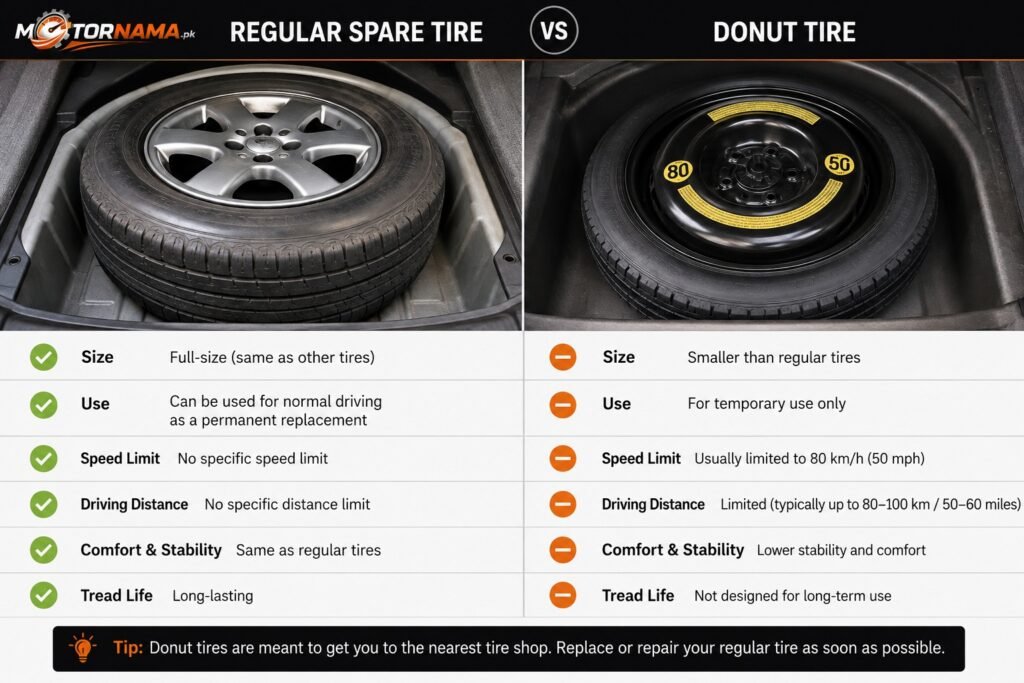
Some modern vehicles do not come with a full-sized spare tire, but they come with a much smaller, space saver spare tire, or what I like to call them, ‘donut spare wheel’. These are exceptionally small, slow-speed tires that can run a vehicle, but they lack the grip, stability, and traction of a full-sized tire. These are only used for emergencies and are feasible for short distances. If you have equipped your vehicle with a space saver spare wheel, you must stop at the nearest service stop and get your regular tire fixed.
Can a Flat Tire Be Repaired?
The probability of a flat tire’s repairability depends on what sort of damage the tire has received when it was punctured. If the puncture was small and was caused by a nail or a screw that got lodged into the tire, or even a faulty nozzle, these small punctures can be easily fixed. As a matter of fact, these are the most common puncture causes in Pakistan as well. The tire repair shop will remove the nail or screw, or change the nozzle, refill it with air, and you will be on your way in no time.
However, there are some other types of punctures that cannot be repaired, and you will need a replacement tire. These include blowouts, large tears, or sidewall damage. In case of accidents, the tire may get shredded as well. These extreme damage scenarios cannot be repaired, and you will need to purchase a brand-new or used tire to drive your vehicle again. If you are travelling on Motorways, I suggest buying a used tire and lowering your driving speed for the rest of the trip. Once you are back home and have access to a trusted shop, only then buy a fresh tire because tire prices are not low in Pakistan.
How Much Does Tire Repair Cost in Pakistan?
Depending on the puncture, the repair price will vary. If you have a smaller puncture, you can either go for a plug repair or a patch repair. The plug repair does not even need the tire to be removed from the vehicle, and the tire repair person can just insert a plug into the hole after cleaning it, and it will hold the air inside the tire. This costs an average of around Rs. 150 to Rs. 300 in Pakistan, depending upon the city and the tire shop.
If you want to go for a patch repair, the tire repair shop will remove the wheel and insert a rubber patch, which is then burned into the small hole or cut. This is a relatively better option for fixing punctures, but it also costs more. A typical patch repair will cost you between Rs. 600 and Rs. 800, depending on the city and tire repair shop.
If you want to get your wheels balanced after a puncture, it will be a separate charge. The final price depends upon the weight used in wheel balancing, but a typical balancing job can range between Rs. 2,500 and Rs. 5,000 depending upon the weight used and shop labor charges. This is commonly done alongside wheel alignment.
If your tire valve is damaged and is constantly leaking air, you will need to purchase a new nozzle for filling the air. This costs around Rs. 500 to Rs. 1000, depending on the quality of the nozzle that you purchase. If your tire is beyond repair, you will need to purchase a brand-new tire. The price of a single tire in Pakistan varies greatly depending on different factors such as brand, country of origin, or whether it is a used one. Used tires normally range between Rs. 5000, to Rs. 10,000. Chinese tires are much cheaper even new, and you can find a single tire between Rs. 15,000 and Rs. 18,000. If you want branded tires like Michelin, Continental, or Dunlop, they are a little on the higher side, with prices ranging between Rs. 25,000 and Rs. 35,000 for a single tire.
| Puncture Type | Estimated Repair Cost Range | ||
| Plug Repair | Rs. 150 to Rs. 300 | ||
| Patch Repair | Rs. 600 to Rs. 800 | ||
| New Valve/Nozzle | Rs. 500 to Rs. 1000 | ||
| Wheel Balancing and Alignment | Rs. 2,500 to Rs. 5,000 | ||
| New Tire | Used | New | |
| Rs. 5,000 to Rs. 10,000 | Chinese | Imported | |
| Rs. 15,000 to Rs. 18,000 | Rs. 25,000 to Rs. 35,000 | ||
What if Your Car Has a Tire Repair Kit Instead of a Spare Tire?
Pakistan has an abundance of imported and local 660cc cars which come with a tire repair kit, instead of a spare tire, to save some boot space and keep the vehicle within the Kei class weight limit. Local 660cc cars like the Suzuki Alto and Japanese imports like the Daihatsu Mira, Daihatsu Move, Honda N-WGN, Nissan Days, Mitsubishi eK Wagon, and Suzuki Wagon R all come with tire repair kits instead of a spare tire. In such cases, you will need to use the tire repair kit to fix the puncture and drive on.
What is Included in a Tire Repair Kit?
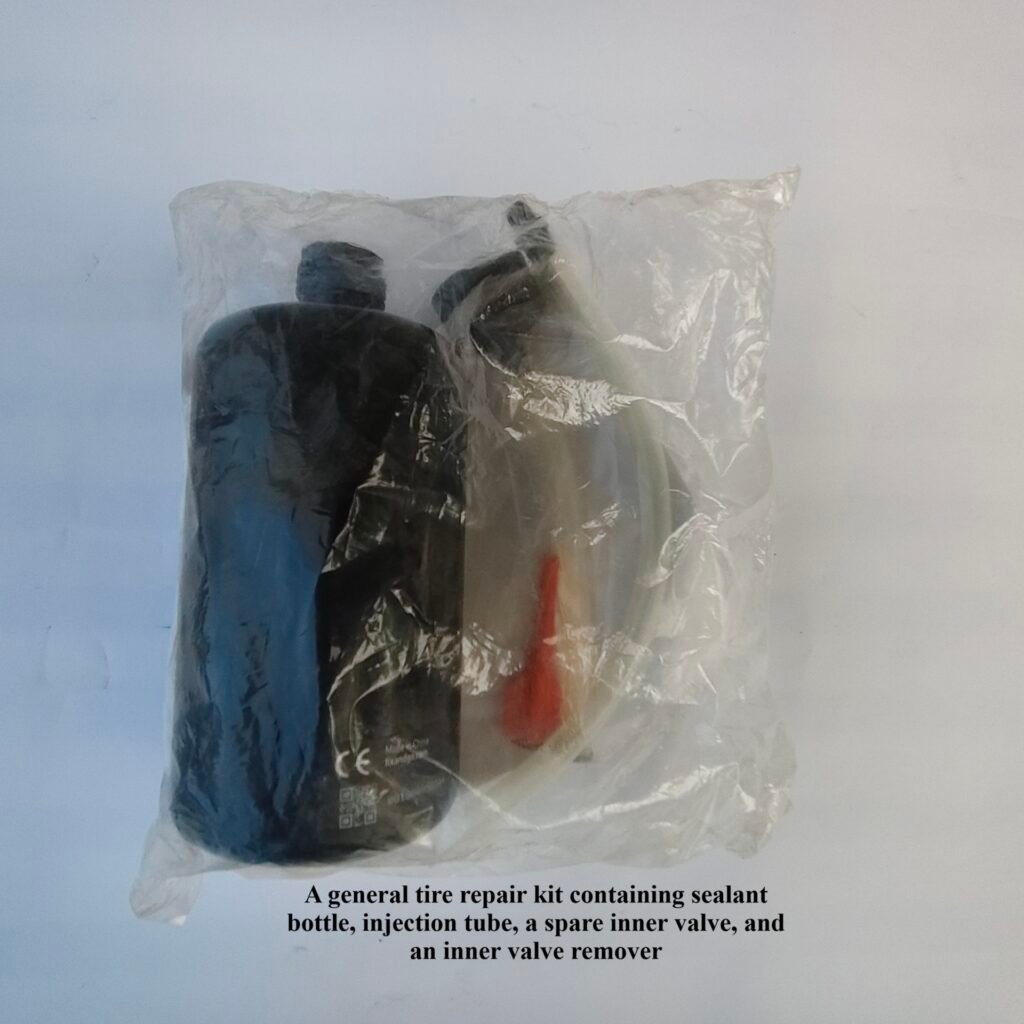
- A tire repair kit usually comes with the following items:
- Tire sealant (repair gel)
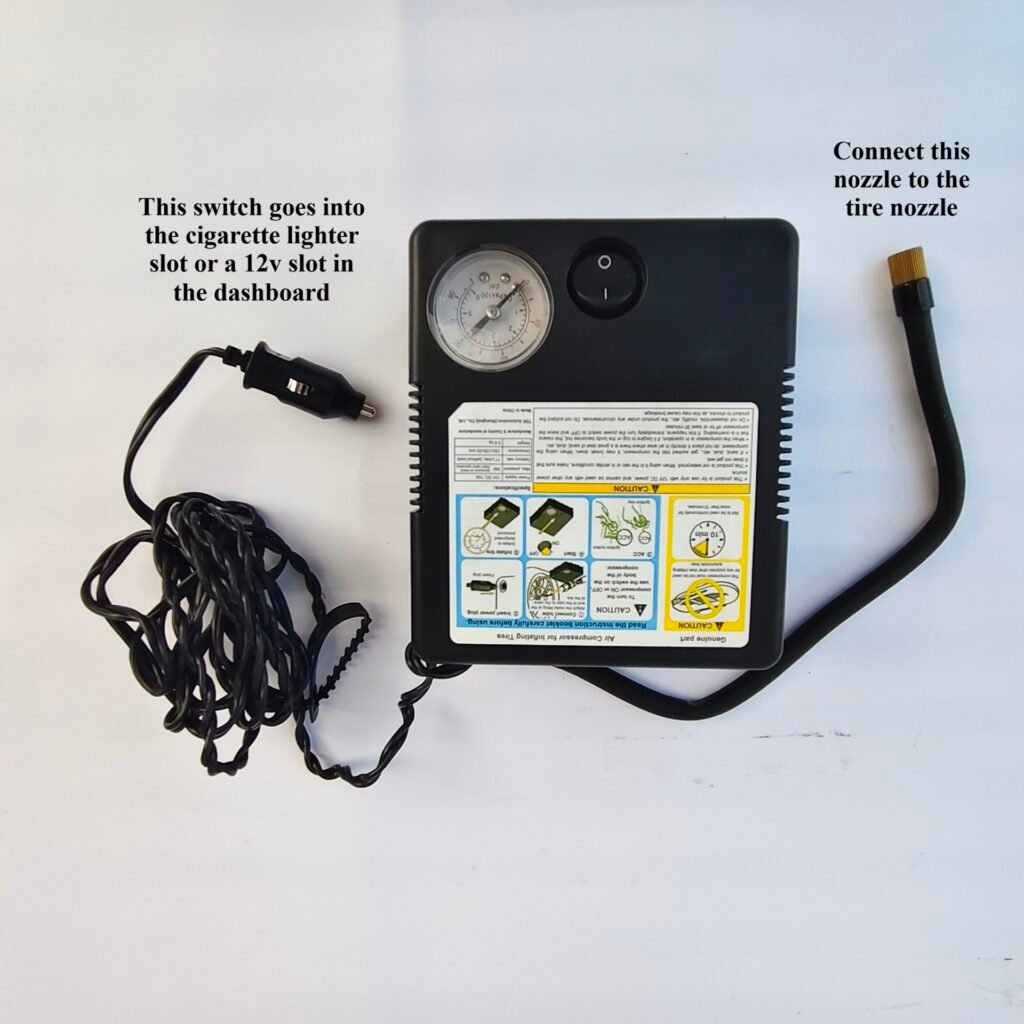
- 12V air compressor
- Inflation hose
- Power cable for the cigarette lighter socket
This kit is designed to temporarily seal small punctures and refill air so that you can drive to the nearest tire shop.
How Does a Tire Repair Kit Work?
The sealant in the repair kit is injected into the tire through the valve stem. After that, an air compressor is used to inflate the tire, and as the tire inflates, the sealant spreads around inside the tire and plugs the small hole to ensure that it does not allow the air to escape the tire, thus keeping it inflated.
Remember: This is not a permanent fix. After using a tire repair kit, you must find and visit a professional tire repair shop to get the puncture fixed permanently.
How to Use a Tire Repair Kit?
- Park the vehicle in a safe location and switch off the engine.
- If possible, remove the object causing the puncture only if your vehicle’s instructions recommend doing so.
- Connect the sealant bottle according to the manufacturer’s instructions.
- Attach the hose to the tire valve.
- Connect the compressor to the vehicle’s 12V power outlet.
- Inflate the tire until it reaches the recommended pressure.
- Drive slowly for around 5–10 km so the sealant spreads evenly inside the tire.
- Stop and recheck the tire pressure. Add more air if necessary.
- Visit the nearest tire repair shop as soon as possible.
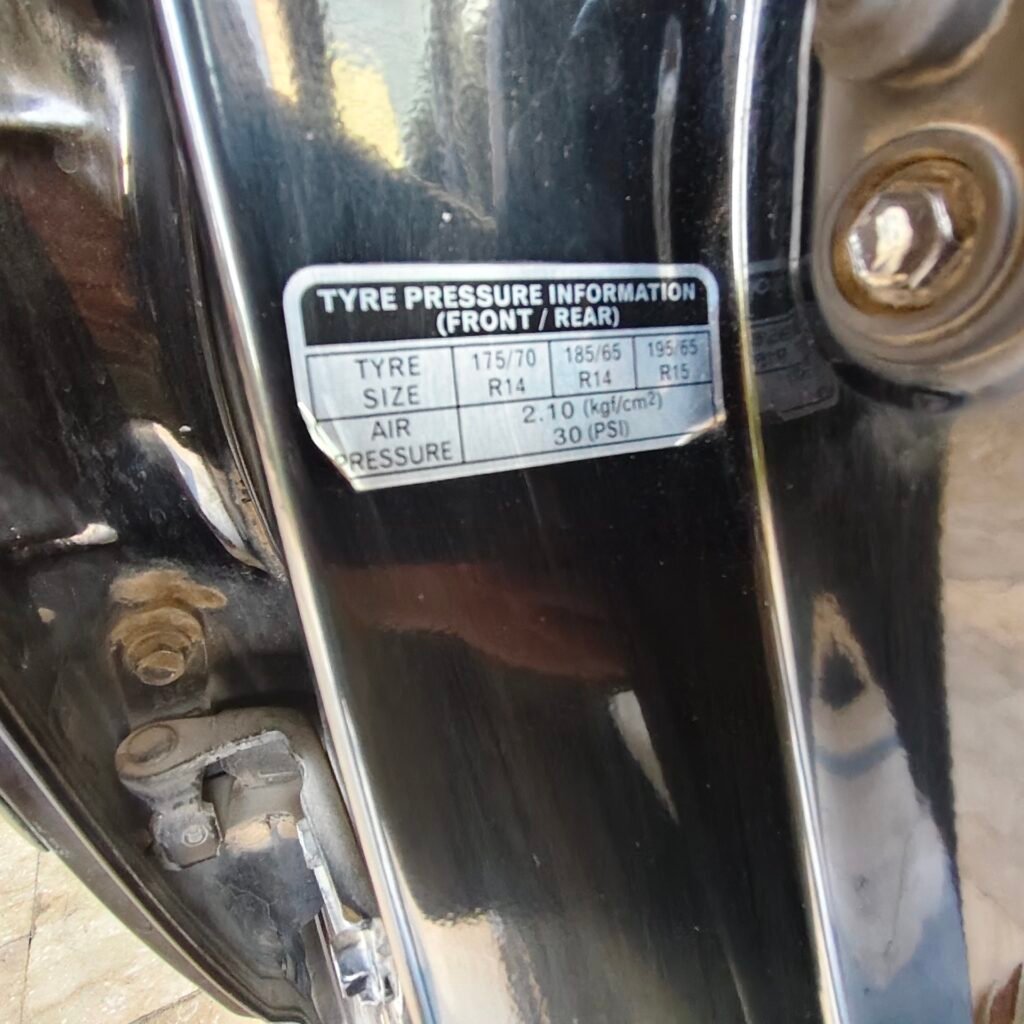
If you are confused about how much air you should put in a tire after fixing the puncture, you can check the tire pressure information sheet, which is found on the sill of the driver’s door.
When a Tire Repair Kit Won’t Work
A tire repair kit can only handle and repair small and minor punctures, typically caused by nails or screws. It should not be used if:
- The tire has a sidewall puncture.
- The tire has suffered a blowout.
- The wheel is bent or cracked.
- The puncture is too large.
- The tire has come off the rim.
- The tire has been driven completely flat for a long distance.
In such situations, driving further will only cause more damage, so you should look for roadside assistance.
How Far Can You Drive After Using Tire Sealant?
While this question revolves around the brand of the tire sealant kit, in most cases, these sealant kits are only good for enough distance to the nearby tire shop. If you have repaired a puncture using a tire repair kit, you should:
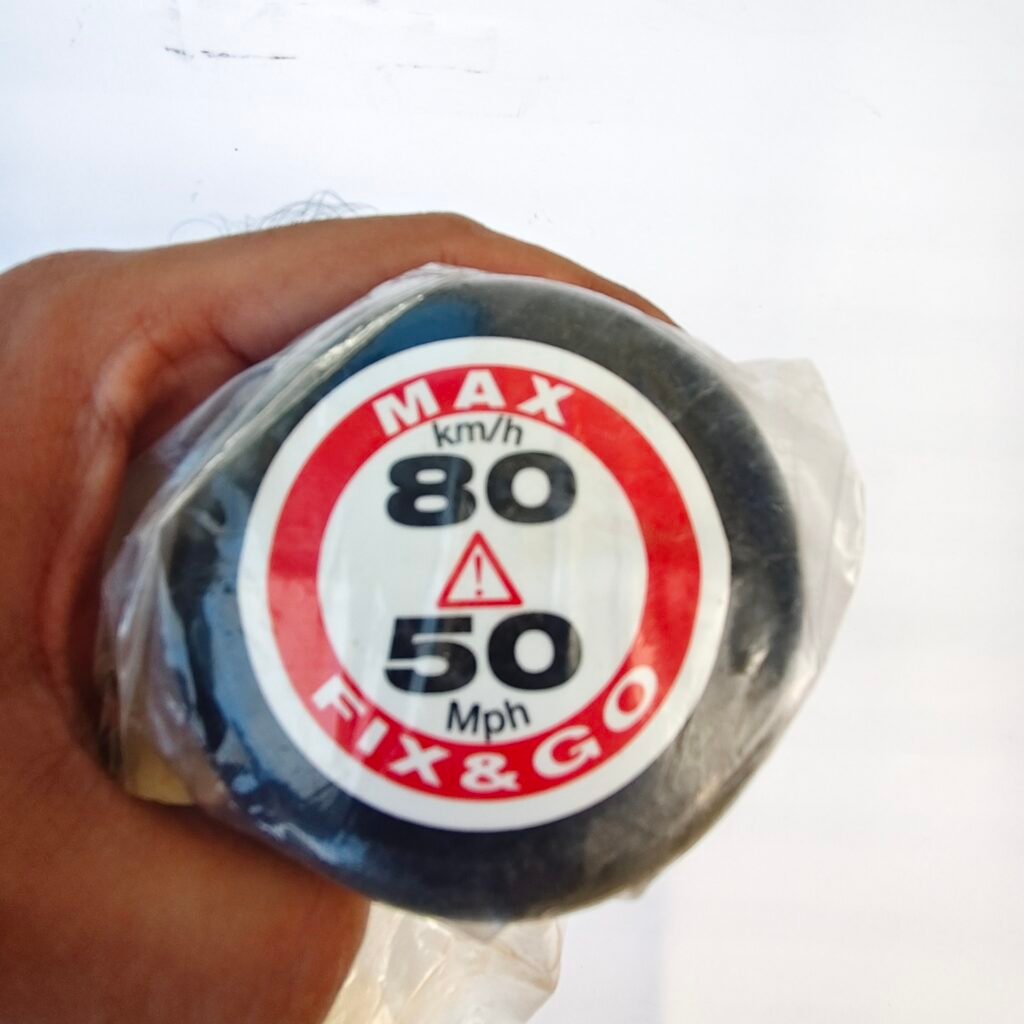
- Keep your speed below 80 km/h (or follow the limit specified by the manufacturer).
- Drive only as far as necessary to reach a tire repair facility.
- Do not treat the repair as permanent.
Can The Tire Be Repaired After Using Sealant?
Yes, a tire repaired with a tire repair kit can be professionally fixed, but the shops may charge more because the sealant will make a mess inside the tire, and the shops will need more time cleaning everything up. If the puncture is from a nail or screw, the repair shop can easily fix it by patching or plugging it.
Comparison Between a Spare Tire and a Tire Repair Kit
| Feature | Spare Tire | Tire Repair Kit |
| Repairs small punctures | ✔ | ✔ |
| Works after a blowout | ✔ | ✖ |
| Sidewall damage | ✔ (by replacing the wheel) | ✖ |
| Takes up boot space | More | Less |
| Weight | Heavy | Lightweight |
| Can continue normal driving | Temporarily | Only to the nearest repair shop |
| Requires physical wheel change | ✔ | ✖ |
How to Prevent Tire Punctures in Pakistan
While it is relatively hard to completely prevent tire punctures in Pakistan because of road conditions and debris found on the roads, there are some preventive measures that you can use to ensure that your tires are in the best condition and are resistant to punctures.
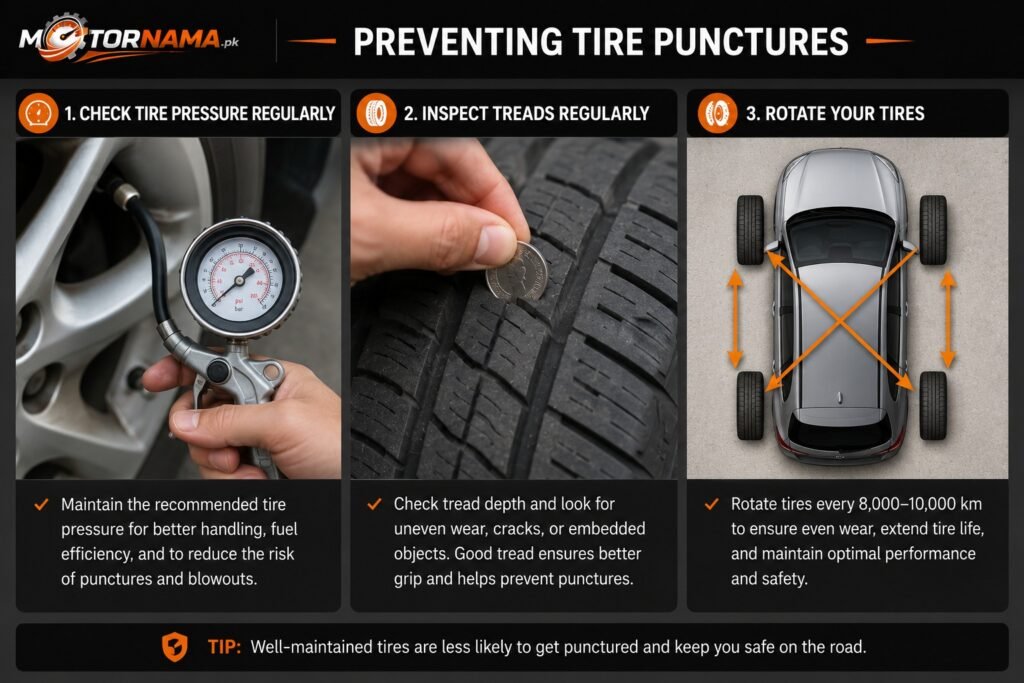
You must check tire pressures weekly, and if the roads are in poor condition where you live, you should do it after every 2 or 3 days. Low tire pressure causes unnecessary strain on tire walls, making them weaker and susceptible to punctures while driving over potholes or bumps.
You must also rotate tires after every 3 or 4 months, which ensures that every tire is degrading equally. The front tires degrade quickly because they are constantly under engine weight, they turn the vehicle, and in FWD vehicles, they also power the vehicle, which means that they often slip under pressure, causing the tire tread to wear quickly. Rotating the tires regularly ensures that all four tires are going under the same type of pressure, and no single tire is degrading more than the other one.
After purchasing a new tire, always keep an eye on tire tread, especially if your vehicle has high usage. A vehicle that runs less will have less tire tread loss, while a vehicle with high usage will quickly go through a set of tires even if the time duration has been less. Keep checking the tire tread on and off and ensure that you switch out tires on a regular interval because new tires are less prone to punctures on bumpy and uneven roads.
You must adjust your driving style and look after your vehicle. Avoid unnecessary loss of traction by giving too much throttle on standstills and low speeds. Also avoid potholes and bumps. If avoiding them is not possible, reduce the speed considerably and drive over them slowly to make sure that the tires do not take too much of a hit from them.
Finally, replace worn tires as soon as possible. Even if your vehicle has very little mileage, rubber has an age. As your vehicle’s tires get old, they will age and become worn out automatically. The most common sign of a worn-out tire is that it will keep running out of air and will quickly get a puncture when you drive it around. In extreme cases, after a full refill of air, they will run out of air within a single night. Never drive your vehicle on worn-out tires, even in emergencies.
Emergency Kit Every Driver Should Carry
There are a few items that should be present in every vehicle to tackle any sort of emergency situation, including a tire puncture. These items include:
- Air compressor
- First aid kit
- Gloves
- Portable jump starter
- Rain poncho
- Reflective triangle
- Spare tire
- Tire pressure gauge
- Torch
That is pretty much everything that you should keep in mind while changing a punctured tire in Pakistan. One thing that I would like to mention here is that, despite understanding and knowing that changing a tire is essential and everyone should know how to do it, one thing must come first, and that is personal safety. Depending on the current situation, if you think that changing the tire will cause problems, simply call roadside assistance, and they will help you out with it.