Punjab’s New Vehicle Scrapping Policy: Will Your Old Car Be Banned?
Inside the new law targeting high-emission transport, the $40M World Bank incentive plan, and why your well-maintained older car might still be safe.

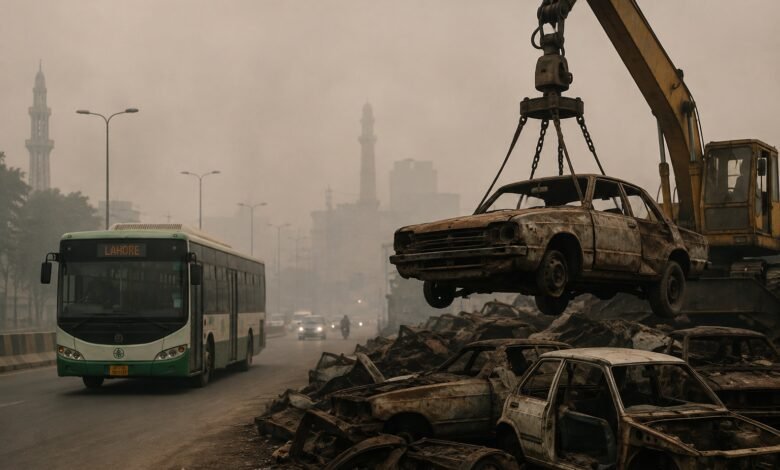
The Government of Punjab has officially introduced a brand-new vehicle scrapping policy under the Provincial Motor Vehicles (Third Amendment) Ordinance 2026. This new policy aims to tackle the region’s severe seasonal smog and improve road safety. It also marks a major shift in how the province handles older, unsafe, and high-emission transport.
Here is everything you need to know about how the policy works, which vehicles are affected, and what it means for owners of older vehicles.

What is the Punjab Vehicle Scrapping Policy?
The new policy provides a strict legal framework to identify, retire, and permanently dismantle End-of-Life Vehicles (ELVs). Instead of letting permanently damaged or heavily polluting cars remain on the roads, the new law ensures that they are safely recycled at government-authorized facilities.
Will My Old Car Be Automatically Scrapped?
No. Despite the initial public rumors, the law does not enforce a strict, mandatory age limit (such as 15 or 20 years) for automatic scrapping.
An older vehicle can remain on the road indefinitely, provided it:
- Passes official provincial vehicle fitness tests.
- Meets established environmental and emission standards
- Maintains a valid, active registration
What Classifies a Vehicle as ‘End-of-Life’ ELV?
A vehicle is legally designated as an ELV based on its mechanical condition, and safety status, rather than its manufacturing date. A vehicle will be flagged for scrapping if it meets any of the following criteria.
- Failed Inspections: It repeatedly fails mandatory fitness or emission tests.
- Severe Damage: It has been rendered unroadworthy by fire, natural disasters, or major accidents.
- Registration Issues: Its registration has been permanently canceled or cannot be legally renewed.
- Owner’s Choice: The owner voluntarily submits the vehicle to be scrapped.
How Does the Scrapping Process Work?
The Government of Punjab is establishing a regulated ecosystem to prevent illegal parts-chopping and environmental contamination. Key points of this ecosystem are:
- Authorized Scrapping Centers (ASCs): Vehicles must be taken to officially licensed recycling facilities.
- Depollution: Facilities safely drain hazardous fluids, including engine oil, coolant, and brake fluid.
- Dismantling: Reusable components and valuable metals are systematically separated.
- Destruction: The core chassis is crushed, ensuring that a particular Vehicle Chassis Number can never be reused on the road.
Why is Punjab Implementing This Now?
The new Punjab Vehicle Scrapping Policy targets three critical provincial crises:
- Combatting Smog: Vehicular emissions are a primary driver of Punjab’s toxic air quality index (AQI) during winter.
- Road Safety: Removing structurally compromised or mechanically unfit vehicles reduces fatal road accidents.
- Modernizing the Vehicles on the roads: The policy lays the groundwork to transition consumers toward cleaner alternatives, including electric vehicles (EVs).
Financial Incentives & Subsidies
- The Vehicle Buyback Scheme: The Punjab government, backed by a planned $40 million allocation from the World Bank under the Punjab Clean Air Program, is setting up financial assistance structures. Owners who scrap commercial vehicles will receive monetary compensation.
- EV Financing Linkage: Authorities plan to link the replacement of older commercial vehicles directly to Electric Vehicle (EV) financing. Scrapping an old transport unit could act as a down payment or subsidy for cheap EV three-wheelers or electric motorcycles.
- Tax Penalty Structure: Rather than a direct discount, the government is introducing disincentives for keeping old cars. The provincial assembly recently withdrew the 25% to 35% token tax concession on 10-year-old vehicles, ensuring older, high-emission cars face higher operational costs.
Major Execution Challenges in Pakistan
Affordability vs. Environment
For low-income families and commercial transport operators, a vehicle is an essential livelihood asset. Forcing people to scrap cars without offering a massive, fully funded upgrade subsidy could spark massive economic backlash.
Corrupt VICS Infrastructure
For the policy to work fairly, the Vehicle Inspection and Certification System (VICS) must be flawless. Historically, fitness certificates in Pakistan can be easily bypassed or illegally bought, meaning heavily polluting vehicles might stay on the road while law-abiding owners face arbitrary penalties.
The Private Scrap Markets
Pakistan has many massive, unregulated informal scrap markets (like Lahore’s Bilal Gunj and Rawalpindi’s Sultan ka Khou). Getting owners to take their cars to government-approved Authorized Scrapping Centers (ASCs), where they only get raw scrap metal value, instead of selling functional spare parts to informal mechanics will require immense enforcement.
Lack of EV Alternatives
The policy heavily relies on pushing drivers toward EVs. However, Pakistan’s localized EV manufacturing is still in its infancy, charging networks are rare, and electricity grid stability remains a massive hurdle.
Related News: Is Pakistan Finally Ready for Electric Cars?
Regional Comparison – Punjab (Pakistan) vs. India
While Pakistan may be new to adapting the vehicle scrapping practice, its neighboring India has been running its national program for several years. India’s National Vehicle Scrappage Policy was implemented nationwide back in 2021 and is now fully active. Comparing both frameworks reveals stark differences in age limits, infrastructure, and manufacturer involvement.
| Feature | Punjab Policy (Pakistan) | National Policy (India) |
| Strict Age Cut-Off | No fixed age rule yet. Focuses entirely on vehicle condition and testing | Yes. Mandatory testing after 15 years for commercial and 20 years for private cars |
| Testing Infrastructure | Relies on the emerging Vehicle Inspection & Certification System (VICS) network | Highly Standardized Automatic Testing Stations (ATS) |
| Scrap Value Benefit | To be determined; likely raw market metal value | 4% to 6% of the vehicle’s original ex-showroom price |
| New Car Purchase Benefits | Direct EV financing linkages, backed by World Bank funds | Up to 25% road tax rebate + registration fee waivers |
| Automaker Mandates | None. Automakers are not legally tied to the policy yet | 5% discount voluntarily offered by car brands upon showing a scrap certificate |
The Punjab Vehicle Scrapping Policy is undoubtedly a step in the right direction for a province choked by seasonal smog. By targeting vehicle fitness rather than a rigid age limit, the government has crafted a fair framework on paper. However, the true test lies in implementation. Without ironclad, corruption-free enforcement at VICS centers and genuine, accessible financial cushions for working-class drivers, this policy risks driving vehicle owners into the informal market rather than toward a greener future.